
Questions
SPHY001 Practice Quiz - Unit 10 | LA050
Single choice
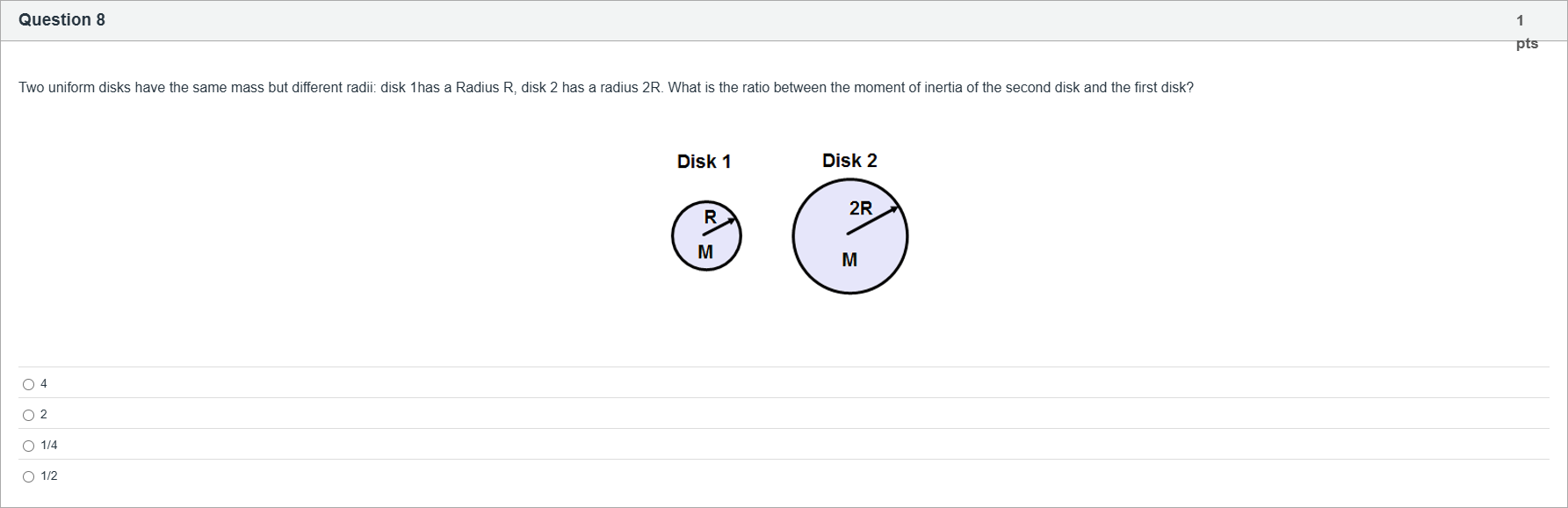
Two uniform disks have the same mass but different radii: disk 1has a Radius R, disk 2 has a radius 2R. What is the ratio between the moment of inertia of the second disk and the first disk?
Options
A.4
B.2
C.1/4
D.1/2

View Explanation
Verified Answer
Please login to view
Step-by-Step Analysis
Let’s parse the problem step by step and compare the moments of inertia for the two disks.
Disk 1 has radius R and Disk 2 has radius 2R, with both having the same mass M. For a uniform disk, the moment of inertia ......Login to view full explanationLog in for full answers
We've collected over 50,000 authentic exam questions and detailed explanations from around the globe. Log in now and get instant access to the answers!
Similar Questions
A 1.2kg mass is located at the origin of an xy coordinate system, a 2.5 kg mass is at x = 2m, y = 0, and a 9kg mass at x = 0, y = 1m. For this arrangement of the three masses, what is the angular acceleration of the system if a torque τ rotates the system about the y axis? All answers in inverse seconds squared.
Question text1. The water volume of the Aral sea was 1093 km3[math] in 1960, and decreased exponentially to 102 km3[math] in 2009. The density of salty water is about 1020 kg/m3[math]. a) Calculate the mass of water lost by the Aral sea from 1960 until 2009. Approximate your answer to 3 significant figures and give the answer in kg. Answer 1 Question 7[input] ×1015kg[math] b) Assume that the mass of the lost water was 9.09×10¹⁴[math] kg and that it was evaporated and redistributed over the surface of Earth as a homogeneous thin spherical shell. This change in mass distribution will result in a change in Earth’s moment of inertia. Assume that initially the lake had all its mass concentrated at a point with coordinates 45°N 60°E (a point mass approximation). Calculate the change in Earth’s moment of inertia due to the redistribution of Lake Aral’s water. Give the answer in kgm2[math] to 3 significant figures (be careful with the sign of the final answer). You may use: -Moment of inertia of homogeneous thin spherical shell with mass M and radius R is: I=(2/3)MR2[math] -Moment of inertia of point mass with mass M and distance r from axis of rotation is: I=Mr2[math] -Radius of Earth=6371 km Answer 2 Question 7[input] ×1027kgm2[math]c) Assume the moment of inertia of Earth in 1960 to be 8.04×1037kgm2[math] and that the change in moment of inertia due to Aral's water evaporation was 6.77×1027kgm2[math]. Conservation of angular momentum tells us that: Iinitial/Tinitial=Ifinal/Tfinal[math] Where I[math] and T[math] are the moment of inertia and Earth’s period of rotation about its own axis (24 hours). Calculate in microseconds the expected change in Earth’s rotation period. Approximate to 2 significant figures.Answer 3 Question 7[input] μs[math]
Question text1. The water volume of the Aral sea was 1093 [math: km3] in 1960, and decreased exponentially to 102 [math: km3] in 2009. The density of salty water is about 1020 [math: kg/m3]. a) Calculate the mass of water lost by the Aral sea from 1960 until 2009. Approximate your answer to 3 significant figures and give the answer in kg. Answer 1 Question 7[input] [math: ×1015kg] b) Assume that the mass of the lost water was [math: 9.09×10¹⁴] kg and that it was evaporated and redistributed over the surface of Earth as a homogeneous thin spherical shell. This change in mass distribution will result in a change in Earth’s moment of inertia. Assume that initially the lake had all its mass concentrated at a point with coordinates 45°N 60°E (a point mass approximation). Calculate the change in Earth’s moment of inertia due to the redistribution of Lake Aral’s water. Give the answer in [math: kgm2] to 3 significant figures (be careful with the sign of the final answer). You may use: -Moment of inertia of homogeneous thin spherical shell with mass M and radius R is: [math: I=(2/3)MR2] -Moment of inertia of point mass with mass M and distance r from axis of rotation is: [math: I=Mr2] -Radius of Earth=6371 km Answer 2 Question 7[input] [math: ×1027kgm2]c) Assume the moment of inertia of Earth in 1960 to be [math: 8.04×1037kgm2] and that the change in moment of inertia due to Aral's water evaporation was [math: 6.77×1027kgm2]. Conservation of angular momentum tells us that: [math: Iinitial/Tinitial=Ifinal/Tfinal] Where [math: I] and [math: T] are the moment of inertia and Earth’s period of rotation about its own axis (24 hours). Calculate in microseconds the expected change in Earth’s rotation period. Approximate to 2 significant figures.Answer 3 Question 7[input] [math: μs]
Two uniform disks have the same mass but different radii: disk 1has a Radius R, disk 2 has a radius 2R. What is the ratio between the moment of inertia of the second disk and the first disk?
More Practical Tools for Students Powered by AI Study Helper
Making Your Study Simpler
Join us and instantly unlock extensive past papers & exclusive solutions to get a head start on your studies!