
Questions
Multiple fill-in-the-blank
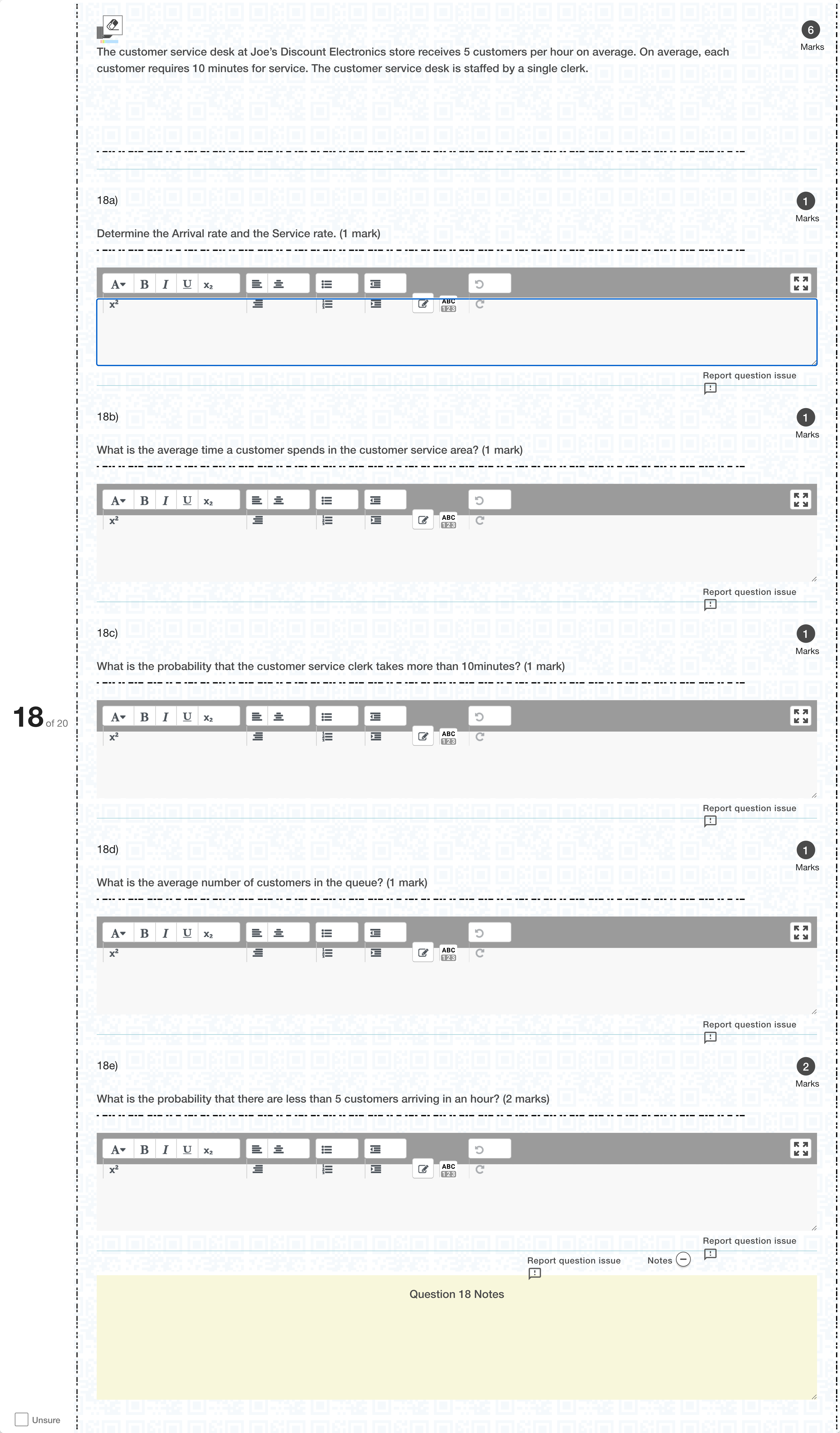
The customer service desk at Joe’s Discount Electronics store receives 5 customers per hour on average. On average, each customer requires 10 minutes for service. The customer service desk is staffed by a single clerk.[Fill in the blank] Determine the Arrival rate and the Service rate. (1 mark)[Fill in the blank] What is the average time a customer spends in the customer service area? (1 mark)[Fill in the blank] What is the probability that the customer service clerk takes more than 10minutes? (1 mark)[Fill in the blank] What is the average number of customers in the queue? (1 mark)[Fill in the blank] What is the probability that there are less than 5 customers arriving in an hour? (2 marks)[Fill in the blank]

View Explanation
Verified Answer
Please login to view
Step-by-Step Analysis
We start by identifying the given data and the appropriate queuing formulas for an M/M/1 system (single server, Poisson arrivals, exponential service):
- Arrival rate lambda = 5 customers per hour.
- Service rate mu = 1 service per 10 minutes = 6 per hour.
Option-by-option analysis:
- Option: Arrival rate and Service rate as the fill-in
This aligns with the given problem data: the arrival rate is 5 per hour and the service rate is 6 per hour, since each customer requires 10 minutes of service on average. No cont......Login to view full explanationLog in for full answers
We've collected over 50,000 authentic exam questions and detailed explanations from around the globe. Log in now and get instant access to the answers!
Similar Questions
Consider a single-server system with exponential arrivals and service. The arrival rate is 0.2 customers per minute, and the average service time is 4 minutes per customer. Compute utilization, average waiting time, and the average queue length.
Suppose that customer interarrival times at a quick serve restaurant are exponentially distributed with an arrival rate of 5 customers per hour. Suppose the average customer service time is 9 minutes and service times exponentially distributed. The goal is to simulate the arrival of 200 customers with the first customer arriving at time 0. Assume that the units for the simulation are in minutes. The spreadsheet below was provided with the quiz. Assume that the correct formulas are entered for the simulation including the formulas for the actual simulation times and the theoretical times, provided by the M/M/1 queuing model, in cells F3 thorough G4. Suppose, to better capture steady state performance, these formulas are based only on the last 100 customers in the 200 customer simulation. All summary times are in minutes. The data table (I7-K307) contains 300 runs of the simulation with summary statistics displayed above. Both the time in system and time in queue statistics are captured in minutes. Which of the following statements are true?
In a consumer society, many adults channel creativity into buying things
Economic stress and unpredictable times have resulted in a booming industry for self-help products
More Practical Tools for International Students
Making Your Study Simpler
Join us and instantly unlock extensive past papers & exclusive solutions to get a head start on your studies!