
Questions
2025 T3 DP DPST1051 BLSC1342 Molecules, Cells and Genes
Single choice
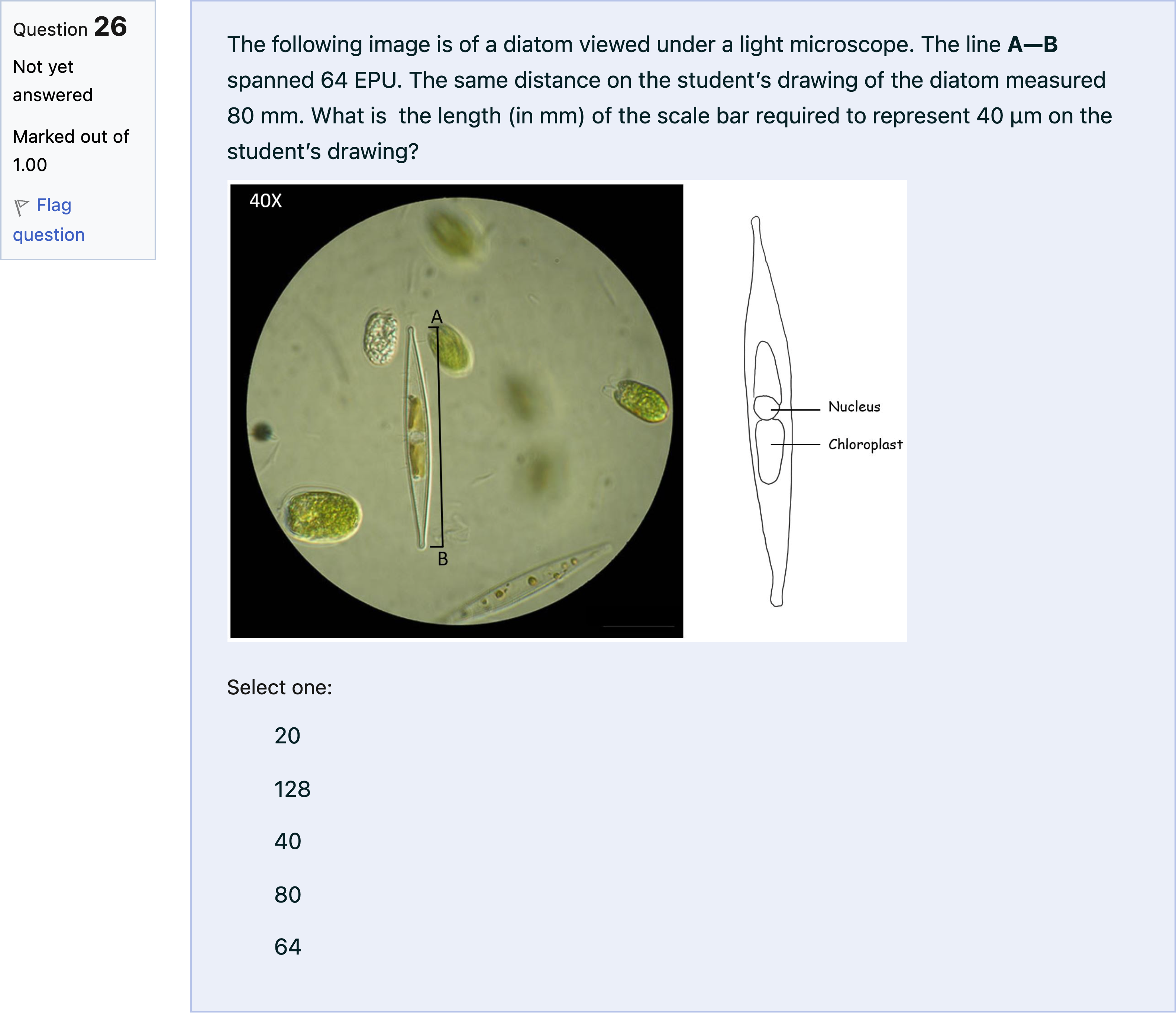
The following image is of a diatom viewed under a light microscope. The line A—B spanned 64 EPU. The same distance on the student’s drawing of the diatom measured 80 mm. What is the length (in mm) of the scale bar required to represent 40 μm on the student’s drawing?
Options
A.20
B.128
C.40
D.80
E.64

View Explanation
Verified Answer
Please login to view
Step-by-Step Analysis
The question asks for the length of the scale bar on the student’s drawing that would represent 40 μm in real size, using the given image measurements.
Option by option analysis:
- Option: 20 mm
This would imply a certain scale factor where a smaller drawing length corresponds to 40 μm, but there is no direct evidence in the data that the scale bar should be this short. Since AB = 80 mm on the drawing for its 64 EPU, the scale is not inherently set to 20 mm for 40 μm unless a specific, unsupported equivalence is assumed, so this ......Login to view full explanationLog in for full answers
We've collected over 50,000 authentic exam questions and detailed explanations from around the globe. Log in now and get instant access to the answers!
Similar Questions
A photograph taken by means of a microscope is called a(n) .
Which part of the compound light microscope helps in gathering and focusing light rays on the specimen to be viewed?
What is the total magnification produced by using a 40x objective and a 10x ocular in a microscope?
Match each type of microscopy with the correct description. 1: The simplest form of light, or optical, microscopes. Light, most often emitted from a standard halogen bulb, enters the microscope from the base (bottom) and is reflected via mirrors towards the sample. 2: Incoming light is in the form of the ultraviolet (UV) spectrum. 3: Can provide detailed images of live cells without staining. 4: Use of beams of electrons (rather than light) to increase its resolution capacity to less than 1nm—that’s 200x. 5: Combines the usefulness of fluorescence microscopy with the ability to visualize cells in 3-D 6: This microscope reflects light off of the specimen at an angle rather than light passing through the specimen.
More Practical Tools for Students Powered by AI Study Helper
Making Your Study Simpler
Join us and instantly unlock extensive past papers & exclusive solutions to get a head start on your studies!