
Questions
Multiple fill-in-the-blank
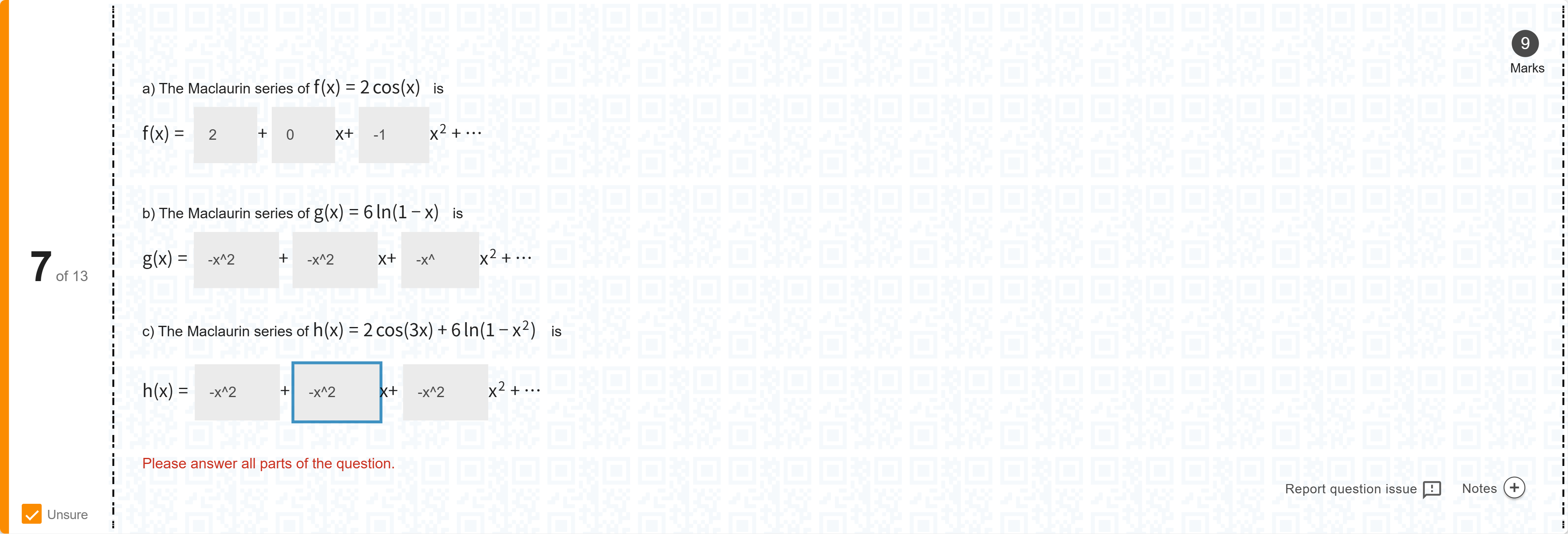
Question text 9Marks a) The Maclaurin series of [math: f(x)=2cos(x)]f(x) = 2\cos(x) is [math: f(x)=]Answer 1[input][math: +]Answer 2[input][math: x+]Answer 3[input][math: x2+⋯]x^2+\cdotsb) The Maclaurin series of [math: g(x)=6ln(1−x)]g(x) = 6\ln(1-x) is [math: g(x)=]Answer 4[input][math: +]Answer 5[input][math: x+]Answer 6[input][math: x2+⋯]x^2+\cdotsc) The Maclaurin series of [math: h(x)=2cos(3x)+6ln(1−x2)]h(x) = 2\cos(3x) + 6\ln(1-x^2) is[math: h(x)=]Answer 7[input][math: +]Answer 8[input][math: x+]Answer 9[input][math: x2+⋯]x^2+\cdotsPlease answer all parts of the question.Notes Report question issue Question 7 Notes

View Explanation
Verified Answer
Please login to view
Step-by-Step Analysis
We need to fill in the Maclaurin (Taylor around 0) series coefficients for three functions and their first few terms.
A) f(x) = 2 cos(x)
- The Maclaurin series for cos(x) is 1 − x^2/2! + x^4/4! − …, i.e., cos(x) = 1 − x^2/2 + x^4/24 − …
- Multiplying by 2 gives f(x) = 2 cos(x) = 2 − x^2 + (2/24) x^4 − … = 2 + 0·x + (−1)·x^2 + …
- Therefore, the constant term is 2, the coefficient of x......Login to view full explanationLog in for full answers
We've collected over 50,000 authentic exam questions and detailed explanations from around the globe. Log in now and get instant access to the answers!
Similar Questions
Question text 9Marks a) The Maclaurin series of [math: f(x)=2cos(x)]f(x) = 2\cos(x) is [math: f(x)=]Answer 1[input][math: +]Answer 2[input][math: x+]Answer 3[input][math: x2+⋯]x^2+\cdotsb) The Maclaurin series of [math: g(x)=6ln(1−x)]g(x) = 6\ln(1-x) is [math: g(x)=]Answer 4[input][math: +]Answer 5[input][math: x+]Answer 6[input][math: x2+⋯]x^2+\cdotsc) The Maclaurin series of [math: h(x)=2cos(3x)+6ln(1−x2)]h(x) = 2\cos(3x) + 6\ln(1-x^2) is[math: h(x)=]Answer 7[input][math: +]Answer 8[input][math: x+]Answer 9[input][math: x2+⋯]x^2+\cdotsNotes Report question issue Question 7 Notes
Question texta) The Maclaurin series of [math: ex2]e^{x^2} is [math: ex2=]e^{x^2} =Answer 1 Question 9[input] [math: +] Answer 2 Question 9[input][math: x] [math: +] Answer 3 Question 9[input][math: x2]x^2 [math: +] Answer 4 Question 9[input][math: x3]x^3 [math: +…]+\ldotsb) The Maclaurin series of [math: ∫0x6ln(1+t)sin(t)dt]\int_0^x 6\ln(1+t)\sin(t) dt is [math: ∫0x6ln(1+t)sin(t)dt=]\int_0^x 6\ln(1+t)\sin(t) dt =Answer 5 Question 9[input] [math: +] Answer 6 Question 9[input][math: x] [math: +] Answer 7 Question 9[input][math: x2]x^2 [math: +] Answer 8 Question 9[input][math: x3]x^3 [math: +…]+\ldotsPlease answer all parts of the question.
Question texta) The Maclaurin series of [math: ex2]e^{x^2} is [math: ex2=]e^{x^2} =Answer 1 Question 9[input] [math: +] Answer 2 Question 9[input][math: x] [math: +] Answer 3 Question 9[input][math: x2]x^2 [math: +] Answer 4 Question 9[input][math: x3]x^3 [math: +…]+\ldotsb) The Maclaurin series of [math: ∫0x6ln(1+t)sin(t)dt]\int_0^x 6\ln(1+t)\sin(t) dt is [math: ∫0x6ln(1+t)sin(t)dt=]\int_0^x 6\ln(1+t)\sin(t) dt =Answer 5 Question 9[input] [math: +] Answer 6 Question 9[input][math: x] [math: +] Answer 7 Question 9[input][math: x2]x^2 [math: +] Answer 8 Question 9[input][math: x3]x^3 [math: +…]+\ldots
What are the constants in the first four terms of the Maclaurin series of \(\cos(x^2)\)? Input in the form \((a_0,a_1,a_2,a_3)\).
More Practical Tools for Students Powered by AI Study Helper
Making Your Study Simpler
Join us and instantly unlock extensive past papers & exclusive solutions to get a head start on your studies!