
Questions
Introduction To Object Oriented Programming (CT044-3-1-IOOP-25-RESIT)
Single choice
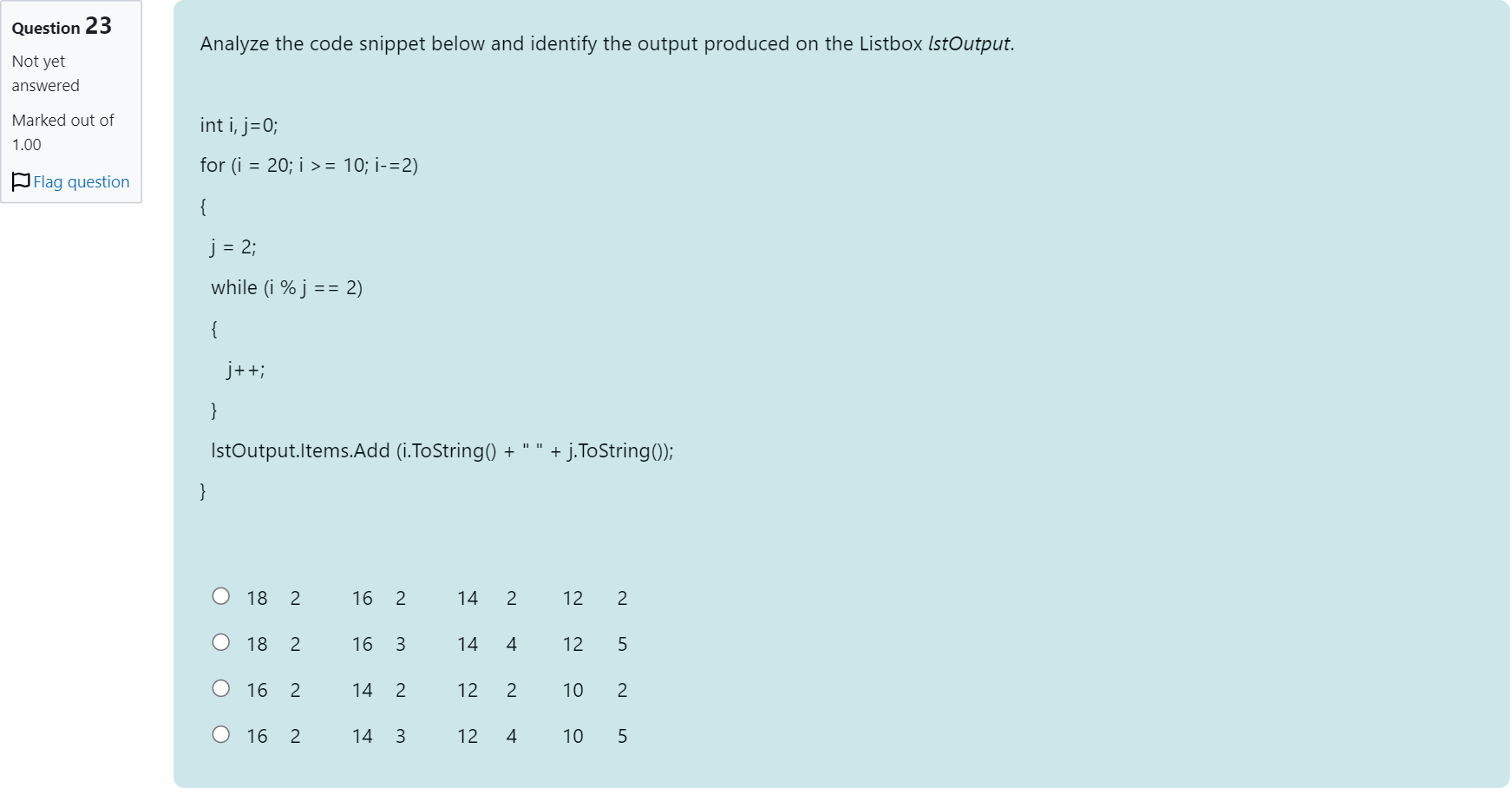
Analyze the code snippet below and identify the output produced on the Listbox lstOutput. int i, j=0; for (i = 20; i >= 10; i-=2) { j = 2; while (i % j == 2) { j++; } lstOutput.Items.Add (i.ToString() + " " + j.ToString()); }
Options
A.18 2 16 2 14 2 12 2
B.18 2 16 3 14 4 12 5
C.16 2 14 2 12 2 10 2
D.16 2 14 3 12 4 10 5

View Explanation
Verified Answer
Please login to view
Step-by-Step Analysis
To tackle this question, I’ll step through the code logic and then examine each answer choice in order.
First, note the outer for loop: for (i = 20; i >= 10; i -= 2). This initializes i at 20 and decrements by 2 each iteration, continuing as long as i is at least 10. Therefore, i takes the values 20, 18, 16, 14, 12, and 10 in sequence.
Next, inside the loop, j is set to 2 on every iteration: j = 2.
Then there is a while loop: while (i % j == 2) { j++; }. This loop increments j as long as the remain......Login to view full explanationLog in for full answers
We've collected over 50,000 authentic exam questions and detailed explanations from around the globe. Log in now and get instant access to the answers!
Similar Questions
Match each loop definition with how many iterations it’ll run for. 1: for k=1:2:10 2: for k=[3,7,10] 3: while 4<pi 4: for k=linspace(1,10,10)
Which of the following pseudocode statements represents a repetition statement?
Which of the following is a drawback of while loops?
For loops are more adaptable than while loops.
More Practical Tools for International Students
Making Your Study Simpler
Join us and instantly unlock extensive past papers & exclusive solutions to get a head start on your studies!