
Questions
EPI 202 Week 5: Self Assessment: Logistic Regression
Single choice
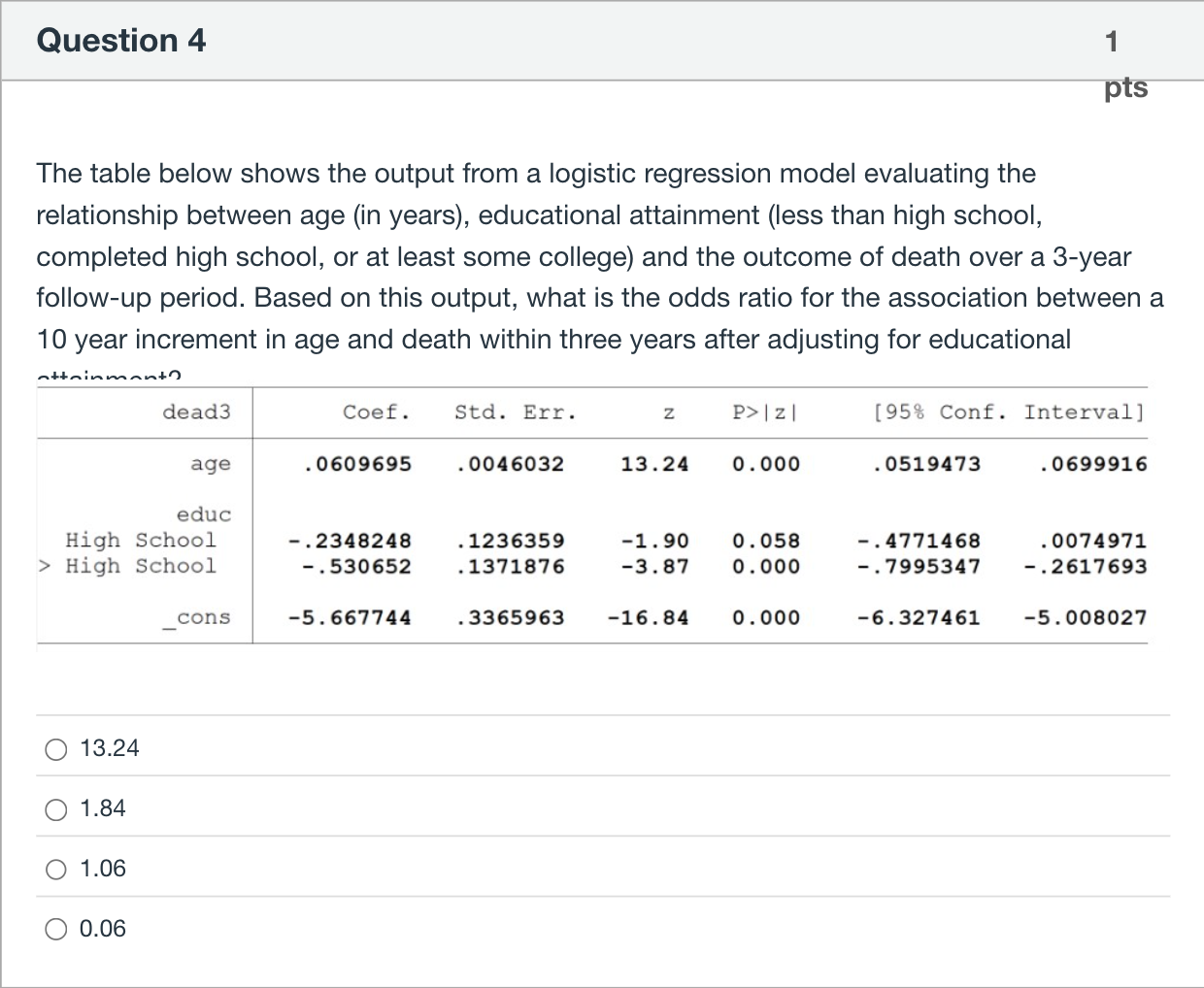
The table below shows the output from a logistic regression model evaluating the relationship between age (in years), educational attainment (less than high school, completed high school, or at least some college) and the outcome of death over a 3-year follow-up period. Based on this output, what is the odds ratio for the association between a 10 year increment in age and death within three years after adjusting for educational attainment?
Options
A.13.24
B.1.84
C.1.06
D.0.06

View Explanation
Verified Answer
Please login to view
Step-by-Step Analysis
To tackle this question, I will parse the table and extract the relevant coefficient and its interpretation.
Option by option evaluation:
- First, identify the reported coefficient for age. The table shows a Coef. for age equal to 0.0609695 with a standard error of 0.0046032. In logistic regression, the coefficient for a predictor is the log odds ratio associated with a one-unit increase in th......Login to view full explanationLog in for full answers
We've collected over 50,000 authentic exam questions and detailed explanations from around the globe. Log in now and get instant access to the answers!
Similar Questions
True or False: The greatest benefit of a logistic regression model with the outcome of ln(probability of disease/(1-probability of disease)) is that it is the most direct way to calculate a cumulative incidence difference.
True or False : Regression models can be used to predict binary outcomes.
The table below shows the output from a logistic regression model evaluating the relationship between age (in years), educational attainment (less than high school, completed high school, or at least some college) and the outcome of death over a 3-year follow-up period. Based on this output, what is the odds ratio for the association between having at least some college education and death within three years after adjusting for age at entry into the cohort?
A marketing team at an e-commerce company wants to predict whether a customer will click on a promotional email (Yes or No). They use logistic regression and include variables such as time of day, customer's past purchase history, and whether the customer has clicked on similar emails in the past. After training the model, they find that customers who clicked on similar emails in the past have a positive coefficient, and those who received the email late at night have a negative coefficient. What does the logistic regression model tell the marketing team about customer behavior?
More Practical Tools for Students Powered by AI Study Helper
Making Your Study Simpler
Join us and instantly unlock extensive past papers & exclusive solutions to get a head start on your studies!