
Questions
MUF0141 Fund. Mathematics Unit 1 - Semester 1, 2025 4.5 Linear Programming Quiz (Formative)
Single choice
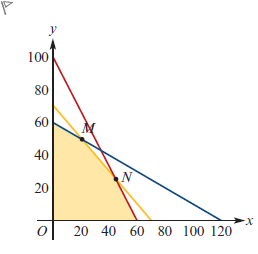
The shaded region in the graph represents the feasible region for a linear programming problem.An objective function Z = ax + by has its value maximised at both vertex M and vertex N.The values of a and b could be:
Options
A.a. a = 15 and b = −15
B.b. a = 15 and b = 25
C.c. a = 25 and b = 50
D.d. a = 15 and b = 15

View Explanation
Verified Answer
Please login to view
Step-by-Step Analysis
We start by restating the problem in our own words to focus on what is being asked: The shaded region is the feasible region for a linear programming problem, and the objective is Z = ax + by. It is given that Z is maximised at both vertex M and vertex N. We need to determine which values of a and b could produce this situation.
First, recall a key fact about linear programming: if an objective function is maximised at two distinct vertices along a common edge, then the level lines of the objective function (lines of constant Z) must be parallel to the edge MN that connects those two vertices. In other words, the slope of the MN edge must equal the slope of the objective function's level lines, which is -a/b when Z = ax + by.
Now, let's analyze the options by comparing them to the slop......Login to view full explanationLog in for full answers
We've collected over 50,000 authentic exam questions and detailed explanations from around the globe. Log in now and get instant access to the answers!
Similar Questions
Solving a linear program can never result in integer values for the decision variables.
Consider the following optimization problem and the constraint boundary lines given below. Maximize profit = 4X + 4Y Constraints 3X + 2Y ≤ 150 X - 2Y ≤ 10 2X + 3Y ≤150 X, Y ≥ 0 If we increase the objective function coefficient of x by 2, i.e., 4 becomes 6, the new optimal solution includes point C.
Consider the following optimization problem and the constraint boundary lines given below. Maximize profit = 4X + 4Y Constraints 3X + 2Y ≤ 150 X - 2Y ≤ 10 2X + 3Y ≤150 X, Y ≥ 0 When the constraint coefficient of x in the blue constraint changes from 1 to 3, the optimal solution changes.
Consider the following Excel sensitivity report and it's accompanying problem: Minimize cost = X + 2Y subject to X + 3Y ≥ 90 8X + 2Y ≥ 160 3X + 2Y ≥120 Y ≤ 70 X, Y≥ 0 Variable Cells Final Reduced Objective Allowable Allowable Cell Name Value Cost Coefficient Increase Decrease $B$3 X 25.71 0 1 2 0.333333333 $C$3 Y 21.43 0 2 1 1.333333333 Constraints Final Shadow Constraint Allowable Allowable Cell Name Value Price R.H. Side Increase Decrease $J$6 LHS 90 0.57 90 62 50 $J$7 LHS 248.57 0 160 88.57142857 1E+30 $J$8 LHS 120 0.14 120 150 28.18181818 $J$9 LHS 21.43 0 70 1E+30 48.57142857 Suppose we add another variable, x3, with an objective function coefficient of 9, and constraint coefficients of 8, 3, and 5 for the first three constraints, respectively. What is the marginal impact of this new variable on the objective function? (In your calculations round all the numbers to 2 decimals.)
More Practical Tools for Students Powered by AI Study Helper
Making Your Study Simpler
Join us and instantly unlock extensive past papers & exclusive solutions to get a head start on your studies!