Still overwhelmed by exam stress? You've come to the right place!
We know exam season has you totally swamped. To support your studies, access Gold Membership for FREE until December 31, 2025! Normally £29.99/month. Just Log In to activate – no strings attached.
Let us help you ace your exams efficiently!

Questions
BU.520.601.T2.FA25 Final Exam
True/False
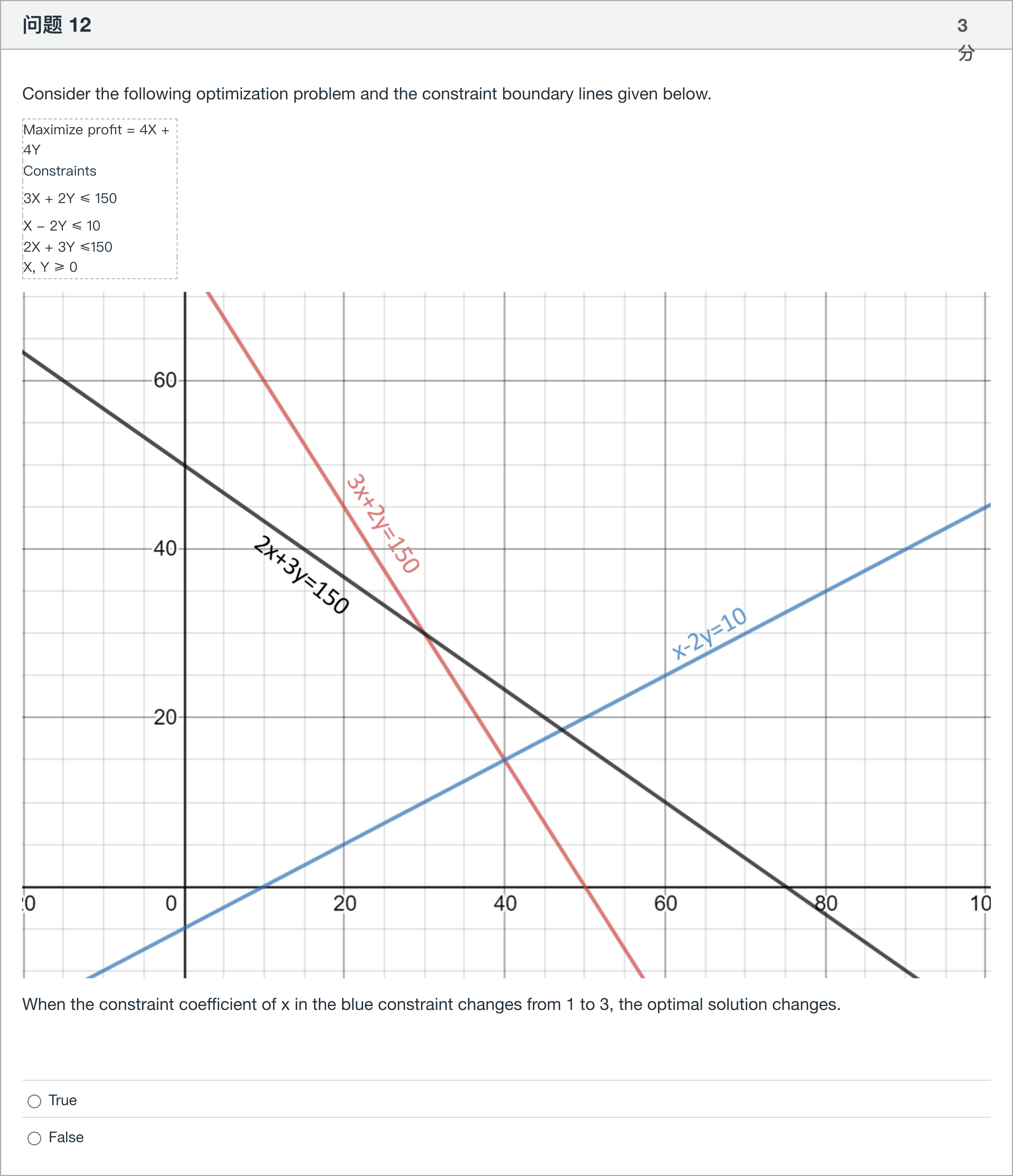
Consider the following optimization problem and the constraint boundary lines given below. Maximize profit = 4X + 4Y Constraints 3X + 2Y ≤ 150 X - 2Y ≤ 10 2X + 3Y ≤150 X, Y ≥ 0 When the constraint coefficient of x in the blue constraint changes from 1 to 3, the optimal solution changes.
Options
A.True
B.False

View Explanation
Standard Answer
Please login to view
Approach Analysis
To analyze whether altering the blue constraint from 1x - 2y ≤ 10 to 3x - 2y ≤ 10 can change the optimal solution, we first restate the problem and the options in our own words. The goal is to maximize profit 4X + 4Y, which is equivalent to maximizing X + Y, subject to the three constraints 3X + 2Y ≤ 150, X - 2Y ≤ 10, 2X + 3Y ≤ 150, and X, Y ≥ 0. The blue constraint line originally has the form X - 2Y = 10 (slope 1/2 when solved for Y), and would become 3X - 2Y = 10 (slope 3/2 when solved for Y) if the coefficient of X changes from 1 to 3.
Option 1 (true): The claim is that changing the coefficient of ......Login to view full explanationLog in for full answers
We've collected over 50,000 authentic exam questions and detailed explanations from around the globe. Log in now and get instant access to the answers!
Similar Questions
Solving a linear program can never result in integer values for the decision variables.
Consider the following optimization problem and the constraint boundary lines given below. Maximize profit = 4X + 4Y Constraints 3X + 2Y ≤ 150 X - 2Y ≤ 10 2X + 3Y ≤150 X, Y ≥ 0 If we increase the objective function coefficient of x by 2, i.e., 4 becomes 6, the new optimal solution includes point C.
Consider the following Excel sensitivity report and it's accompanying problem: Minimize cost = X + 2Y subject to X + 3Y ≥ 90 8X + 2Y ≥ 160 3X + 2Y ≥120 Y ≤ 70 X, Y≥ 0 Variable Cells Final Reduced Objective Allowable Allowable Cell Name Value Cost Coefficient Increase Decrease $B$3 X 25.71 0 1 2 0.333333333 $C$3 Y 21.43 0 2 1 1.333333333 Constraints Final Shadow Constraint Allowable Allowable Cell Name Value Price R.H. Side Increase Decrease $J$6 LHS 90 0.57 90 62 50 $J$7 LHS 248.57 0 160 88.57142857 1E+30 $J$8 LHS 120 0.14 120 150 28.18181818 $J$9 LHS 21.43 0 70 1E+30 48.57142857 Suppose we add another variable, x3, with an objective function coefficient of 9, and constraint coefficients of 8, 3, and 5 for the first three constraints, respectively. What is the marginal impact of this new variable on the objective function? (In your calculations round all the numbers to 2 decimals.)
A constraint is binding if it left hand side of a constraint is equal to the right hand side after the optimal solution is plugged into the constraint function.
More Practical Tools for International Students
Making Your Study Simpler
To make preparation and study season easier for more international students, we've decided to open up Gold Membership for a limited-time free trial until December 31, 2025!