
Questions
MCD2130 - T2 - 2025 10.7 Online Quiz - MCD2130_QUIZ_NINE Circular Functions, Continuity and Differentiability
Short answer
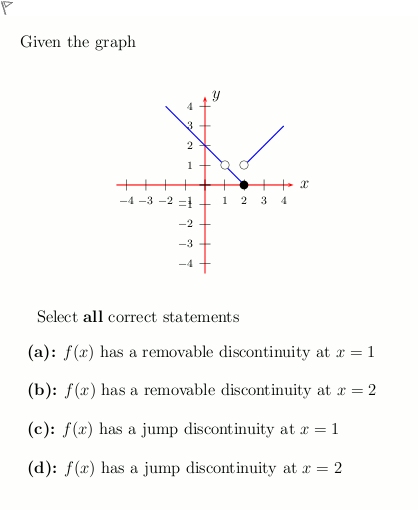
MTH1010_09_10_3

View Explanation
Verified Answer
Please login to view
Step-by-Step Analysis
The given JSON for this item includes a short answer with the numeric value 8 as the correct answer, but there are no answer options provided to analyze. Because the analysis of multiple statements about discontinuities depends on the exact text of each option, I cannot evaluate which statements are correct or incorrect withou......Login to view full explanationLog in for full answers
We've collected over 50,000 authentic exam questions and detailed explanations from around the globe. Log in now and get instant access to the answers!
Similar Questions
Suppose that with a certain phone company, an international long distance phone call from Canada to Brazil costs $0.90 for the first minute (up to and including 60 seconds), plus $0.50 for each additional minute or part of a minute. Note: "Part of a minute" means that if a new minute is started even just by one second, a full minute is charged. For example, a 5 min 1 sec phone call costs the same as a 5 min 50 sec phone call and the same as a 6 min 0 sec phone call. Suppose 𝐶 ( 𝑡 ) is the function that gives the cost of making a 𝑡 minute long phone call. On a piece of paper, sketch a graph showing 𝐶 ( 𝑡 ) (with 𝐶 on the 𝑦 -axis and 𝑡 on the 𝑥 -axis). Then use your graph to evaluate each of the following: (Write DNE for undefined.) 𝐶 ( 2.5 ) = [ Select ] DNE 1.9 1.4 2.4 2.9 𝐶 ( 4 ) = [ Select ] 3.4 1.9 2.9 2.4 DNE lim 𝑥 → 3.1 𝐶 ( 𝑡 ) = [ Select ] 1.9 1.4 2.9 2.4 DNE lim 𝑥 → 4 − 𝐶 ( 𝑡 ) = [ Select ] 2.4 1.4 2.9 1.9 DNE lim 𝑥 → 4 + 𝐶 ( 𝑡 ) = [ Select ] DNE 2.9 2.4 3.4 1.9 lim 𝑥 → 4 𝐶 ( 𝑡 ) = [ Select ] 1.9 2.9 DNE 3.4 2.4
Consider this graph of the function 𝑓 ( 𝑥 ) . Which of the following statements are true and which are false? lim 𝑥 → 3 − 𝑓 ( 𝑥 ) = lim 𝑥 → 3 + 𝑓 ( 𝑥 ) [ Select ] False True lim 𝑥 → 1 𝑓 ( 𝑥 ) = 𝑓 ( 1 ) [ Select ] True False 𝑓 ( 𝑥 ) has a vertical asymptote at 𝑥 = 4 . [ Select ] False True 𝑓 ( 𝑥 ) has a vertical asymptote at 𝑥 = 6 . [ Select ] False True lim 𝑥 → 4 − 𝑓 ( 𝑥 ) = lim 𝑥 → 4 + 𝑓 ( 𝑥 ) [ Select ] False True lim 𝑥 → 4 𝑓 ( 𝑥 ) = ∞ [ Select ] True False lim 𝑥 → 6 𝑓 ( 𝑥 ) = ∞ [ Select ] False True The limit lim 𝑥 → 4 𝑓 ( 𝑥 ) exists, but lim 𝑥 → 6 𝑓 ( 𝑥 ) does not exist. [ Select ] False True
Consider the function 𝑓 ( 𝑥 ) = { 𝑥 2 + 1 𝑖 𝑓 𝑥 < 2 3 𝑖 𝑓 𝑥 = 2 7 − 𝑥 𝑖 𝑓 𝑥 > 2 . We aim to find out if 𝑓 ( 𝑥 ) has a discontinuity at 𝑥 = 2 , and if so, of what type. In order to do that, first find the following information: 𝑓 ( 2 ) = [ Select ] 5 3 2 7 lim 𝑥 ⟶ 2 − 𝑓 ( 𝑥 ) = [ Select ] 7 3 2 5 lim 𝑥 ⟶ 2 + 𝑓 ( 𝑥 ) = [ Select ] 5 7 2 3 Is 𝑓 ( 𝑥 ) continuous or discontinuous at 𝑥 = 2 ? [ Select ] discontinuous continuous If 𝑓 ( 𝑥 ) is discontinuous at 𝑥 = 2 , what type of discontinuity is it? [ Select ] f is continuous An infinite discontinuity A removable discontinuity A jump discontinuity
Consider this graph of the function 𝑓 ( 𝑥 ) . Which of the following statements are true and which are false? lim 𝑥 → 3 − 𝑓 ( 𝑥 ) = lim 𝑥 → 3 + 𝑓 ( 𝑥 ) [ Select ] False True lim 𝑥 → 1 𝑓 ( 𝑥 ) = 𝑓 ( 1 ) [ Select ] False True 𝑓 ( 𝑥 ) has a vertical asymptote at 𝑥 = 4 . [ Select ] True False 𝑓 ( 𝑥 ) has a vertical asymptote at 𝑥 = 6 . [ Select ] False True lim 𝑥 → 4 − 𝑓 ( 𝑥 ) = lim 𝑥 → 4 + 𝑓 ( 𝑥 ) [ Select ] True False lim 𝑥 → 4 𝑓 ( 𝑥 ) = ∞ [ Select ] False True lim 𝑥 → 6 𝑓 ( 𝑥 ) = ∞ False The limit lim 𝑥 → 4 𝑓 ( 𝑥 ) exists, but lim 𝑥 → 6 𝑓 ( 𝑥 ) does not exist. [ Select ] True False
More Practical Tools for Students Powered by AI Study Helper
Making Your Study Simpler
Join us and instantly unlock extensive past papers & exclusive solutions to get a head start on your studies!