
Questions
MUF0121 Physics Unit 1 - Semester 2, 2025
Single choice
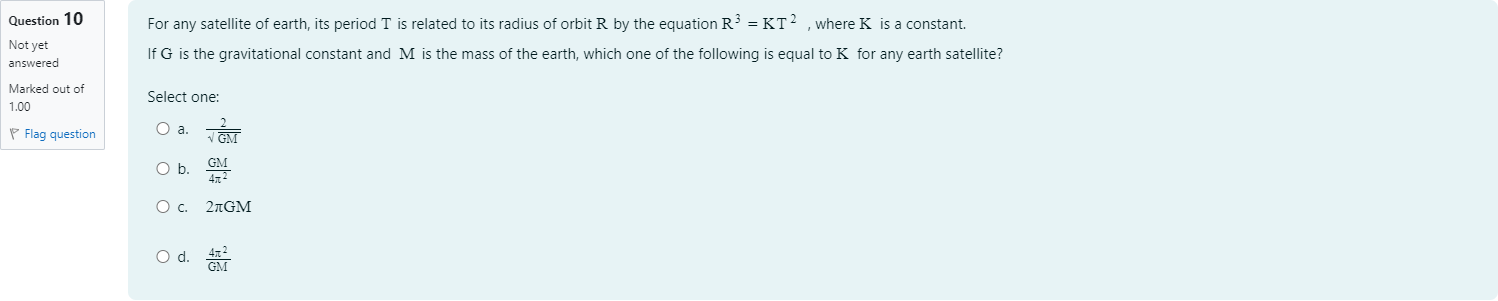
For any satellite of earth, its period [math: T] is related to its radius of orbit [math: R] by the equation [math: R3=KT2] R^{3}=KT^{2} , where [math: K] is a constant. If [math: G] is the gravitational constant and [math: M] is the mass of the earth, which one of the following is equal to [math: K] for any earth satellite?
Options
A.a. [math: 2GM]\frac{2}{\sqrt{GM}}
B.b. [math: GM4π2] \frac{GM}{4\pi^2}
C.c. [math: 2πGM] 2\pi GM \\
D.d. [math: 4π2GM] \frac{4\pi^2}{GM}

View Explanation
Verified Answer
Please login to view
Step-by-Step Analysis
We start by recognizing the standard relation for a satellite in orbit: T^2 is proportional to R^3, with the proportionality constant involving G and M. The problem states R^3 = K T^2, so K must be the factor that converts T^2 to R^3.
First, recall the classical formula for orbital motion in a gravitational field: T^2 = ......Login to view full explanationLog in for full answers
We've collected over 50,000 authentic exam questions and detailed explanations from around the globe. Log in now and get instant access to the answers!
Similar Questions
By using either the Doppler or Transit methods, you can determine the orbital period of the planet. Using just that information, what else can you determine about the planet? (Hint: think Kepler's laws).
A planet in our solar system whose orbital semi-major axis is larger than that of the Earth's will have an orbital period, compared to the Earth, which is
Kepler's third law states that the square of the orbital period of a planet is proportional to
How do Astronomers measure the mass of the Sun (about 2x1030kg!)?
More Practical Tools for Students Powered by AI Study Helper
Making Your Study Simpler
Join us and instantly unlock extensive past papers & exclusive solutions to get a head start on your studies!