
Questions
Multiple fill-in-the-blank
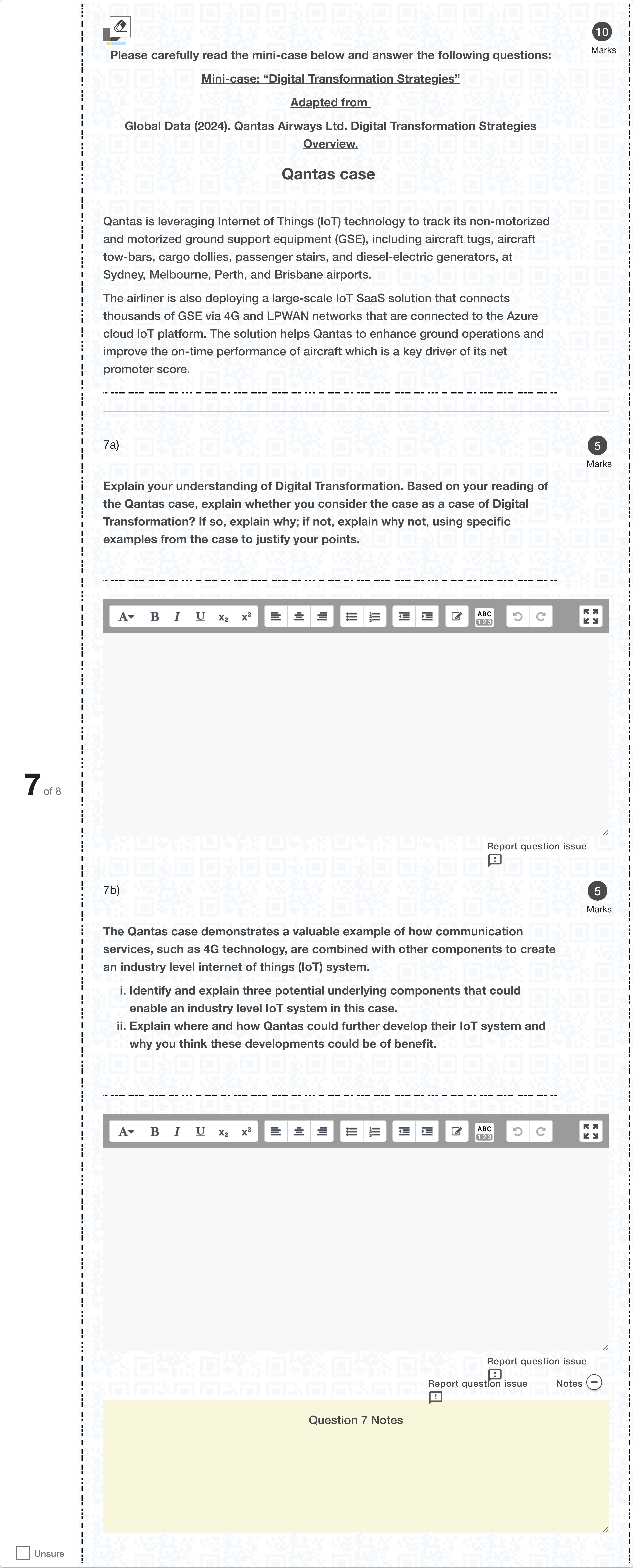
Please carefully read the mini-case below and answer the following questions: Mini-case: “Digital Transformation Strategies” Adapted from Global Data (2024). Qantas Airways Ltd. Digital Transformation Strategies Overview. Qantas case Qantas is leveraging Internet of Things (IoT) technology to track its non-motorized and motorized ground support equipment (GSE), including aircraft tugs, aircraft tow-bars, cargo dollies, passenger stairs, and diesel-electric generators, at Sydney, Melbourne, Perth, and Brisbane airports. The airliner is also deploying a large-scale IoT SaaS solution that connects thousands of GSE via 4G and LPWAN networks that are connected to the Azure cloud IoT platform. The solution helps Qantas to enhance ground operations and improve the on-time performance of aircraft which is a key driver of its net promoter score.[Fill in the blank] Explain your understanding of Digital Transformation. Based on your reading of the Qantas case, explain whether you consider the case as a case of Digital Transformation? If so, explain why; if not, explain why not, using specific examples from the case to justify your points.[Fill in the blank] The Qantas case demonstrates a valuable example of how communication services, such as 4G technology, are combined with other components to create an industry level internet of things (IoT) system. Identify and explain three potential underlying components that could enable an industry level IoT system in this case. Explain where and how Qantas could further develop their IoT system and why you think these developments could be of benefit.[Fill in the blank]

View Explanation
Verified Answer
Please login to view
Step-by-Step Analysis
The prompt provides a mini-case about Qantas’ use of IoT to track GSE and a large-scale IoT SaaS solution connected to Azure, and asks for two sub-parts: 7a) a definition/explanation of Digital Transformation and whether the Qantas case qualifies as Digital Transformation with justification, and 7b) identification of three underlying components for an industry-level IoT system in this case, plus suggestions for further development. Note that the provided data includes the candidate answers for both sub-parts but does not present separate multiple-choice options to evaluate against; instead, it offers full proposed responses for 7a and 7b. Below I analyze the ideas in those provided responses, addressing what would be correct or incorrect and why, and I also point out any gaps or areas for refinement.
7a) Provided answer content and analysis:
- The answer defines Digital Transformation as the integration of digital technologies into all areas of a business, fundamentally changing how the organization operates and delivers value, often involving new tools and processes to improve efficiency, agility, and customer satisfaction. This aligns with standard scholarly and industry definitions, emphasi......Login to view full explanationLog in for full answers
We've collected over 50,000 authentic exam questions and detailed explanations from around the globe. Log in now and get instant access to the answers!
Similar Questions
Which of the following is/are true about smart devices? i. Smart devices must be embedded devicesii. Perform task autonomouslyiii. It must operate with an operating system iv. Smart devices are also an IoT devices
The integration of devices with the ERP systems will lead to exciting opportunities for radically changing the way business is done in the future.
IoT refers to the billions of devices that are connected to the .
Which of the following is an example of Body Area Network (BAN) IoT application?
More Practical Tools for Students Powered by AI Study Helper
Making Your Study Simpler
Join us and instantly unlock extensive past papers & exclusive solutions to get a head start on your studies!