
Questions
CVEN90051_2025_SM2 Exam: Civil Hydraulics (CVEN90051_2025_SM2)- Requires Respondus LockDown Browser
Numerical
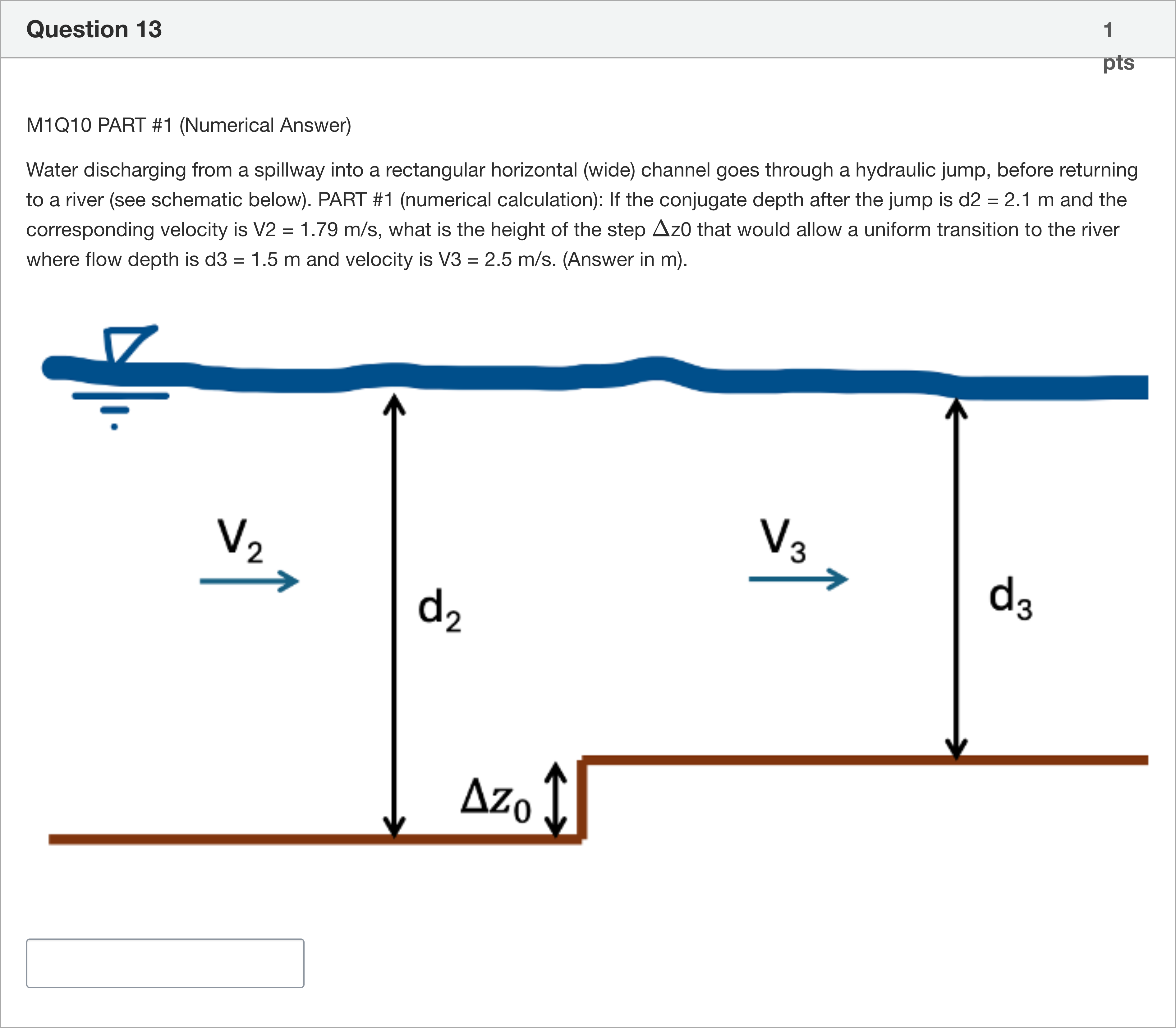
M1Q10 PART #1 (Numerical Answer) Water discharging from a spillway into a rectangular horizontal (wide) channel goes through a hydraulic jump, before returning to a river (see schematic below). PART #1 (numerical calculation): If the conjugate depth after the jump is d2 = 2.1 m and the corresponding velocity is V2 = 1.79 m/s, what is the height of the step Δ z0 that would allow a uniform transition to the river where flow depth is d3 = 1.5 m and velocity is V3 = 2.5 m/s. (Answer in m).

View Explanation
Verified Answer
Please login to view
Step-by-Step Analysis
Restating the problem in my own words: We have water discharging from a spillway into a rectangular wide channel. The flow goes through a hydraulic jump with conjugate depths d2 = 2.1 m and d3 = 1.5 m, and corresponding velocities V2 = 1.79 m/s and V3 = 2.5 m/s. We are asked to determine the height of the step Δz0 that would allow a uniform transition to the downstream river where the flow depth is d3 = 1.5 m and velocity is V3 = 2.5 m/s. The numerical answer given is -0.44 m, but there are no multiple-choice options to analyze here; instead, I’ll lay out the reasoning steps you would use to compute Δz0 and explain how each piece fits together.
Step 1: Check continuity (conservation of discharge) across the jump and downstream reach
- For a rectangular channel of constant width, discharge per unit width q is q = d · V. If the flow is to be uniform downstream after the jump, the same q should be carried through the jump and into the downstream reach (assuming no lateral losses and a single prescribed width).
- Compute q2 = d2 × V2 = 2.1 m × 1.79......Login to view full explanationLog in for full answers
We've collected over 50,000 authentic exam questions and detailed explanations from around the globe. Log in now and get instant access to the answers!
Similar Questions
M1Q9 PART #3 (Numerical Answer) The jet emerging from an underflow vertical sluice gate contracts at the "vena contracta" just downstream of the gate, where the depth is 0.7 m. Downstream of the gate, where the flow is unaffected, water depth coincides with the normal depth dn = 3.2 m. The channel has got a rectangular cross section 8 m wide, n = 0.03 and slope S0 = 0.002. PART #3 (numerical calculation): Relative to the vena contracta, at what distance will the hydraulic jump start? (Use a single calculation step only). (Answer in m).
M1Q9 PART #2 (Numerical Answer) The jet emerging from an underflow vertical sluice gate contracts at the "vena contracta" just downstream of the gate, where the depth is 0.7 m. Downstream of the gate, where the flow is unaffected, water depth coincides with the normal depth dn = 3.2 m. The channel has got a rectangular cross section 8 m wide, n = 0.03 and slope S0 = 0.002. PART #2 (numerical calculation): What is the depth immediately upstream of the hydraulic jump? (Answer in m).
M1Q10 PART #2 (METHOD) Water discharging from a spillway into a rectangular horizontal (wide) channel goes through a hydraulic jump, before returning to a river (see schematic below). PART #2 (method): Which method could be used to determine the height of this step?
M1Q9 PART #4 (METHOD) The jet emerging from an underflow vertical sluice gate contracts at the "vena contracta" just downstream of the gate, where the depth is 0.7 m. Downstream of the gate, where the flow is unaffected, water depth coincides with the normal depth dn = 3.2 m. The channel has got a rectangular cross section 8 m wide, n = 0.03 and slope S0 = 0.002. PART #4 (method): Which method could be used to determine the hydraulic jump location?
More Practical Tools for Students Powered by AI Study Helper
Making Your Study Simpler
Join us and instantly unlock extensive past papers & exclusive solutions to get a head start on your studies!