
Questions
UCIC 202503 PHYS101 Quiz 6
Single choice
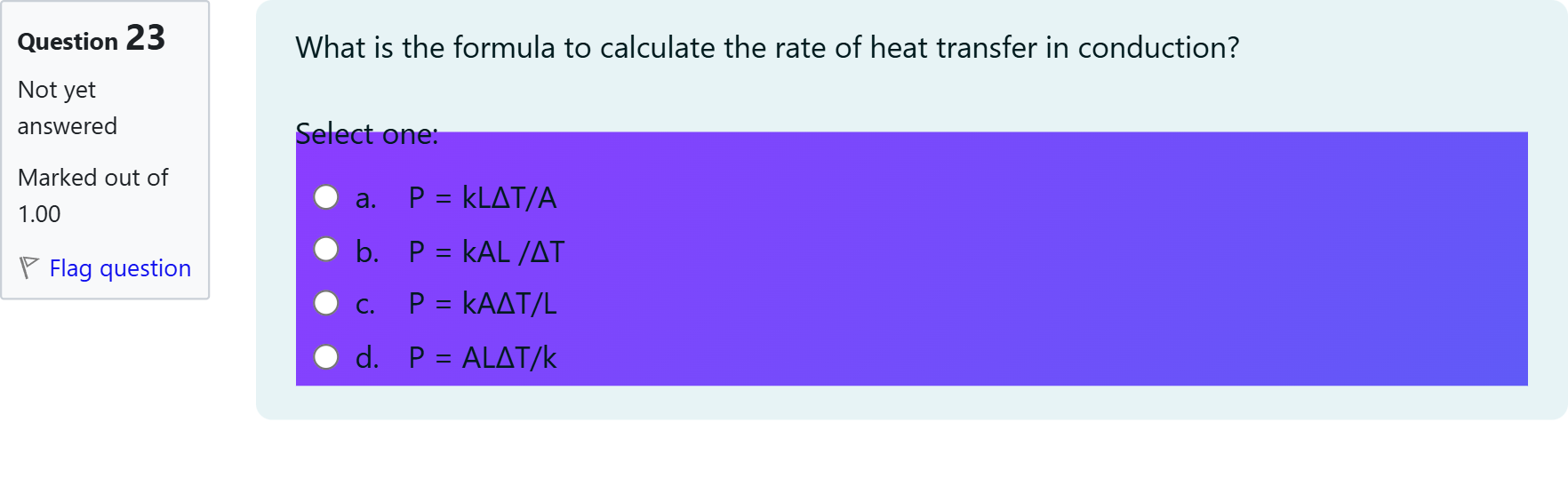
What is the formula to calculate the rate of heat transfer in conduction?
Options
A.a. P = kLΔT/A
B.b. P = kAL /ΔT
C.c. P = kAΔT/L
D.d. P = ALΔT/k

View Explanation
Verified Answer
Please login to view
Step-by-Step Analysis
The question asks for the formula to calculate the rate of heat transfer in conduction.
Option a) P = kLΔT/A: This rearranges the factors incorrectly; it places L where L should be in the denominator and A in the denominator as well, which does not......Login to view full explanationLog in for full answers
We've collected over 50,000 authentic exam questions and detailed explanations from around the globe. Log in now and get instant access to the answers!
Similar Questions
Question text1. The one-dimensional heat flow equation is: [math: ρCP∂T∂t=κ∂2T∂z2+A] where ρ, Cp, and κ are the density, specific heat and thermal conductivity, and A represents heat sinks and sources. The boundary conditions in a given system are: (i) T=320 K at z=0 (ii) T=1200 K at z=40 km and we also have [math: κ=3Wm−1K−1]. Assuming no internal heat sources, calculate a) The thermal gradient of the equilibrium geotherm in [math: K/km] to two significant figures.Thermal gradient = Answer 1 Question 3[input] [math: K/km] [6] b) The temperature at a depth of 100km as predicted by this geotherm model. Give answer in K to two significant figures. T(z=100 km) = Answer 2 Question 3[input] K [4]
Question text1. The one-dimensional heat conduction equation for a cooling dyke with no internal heating can be written: [math: ∂T∂t=κ∂2T∂x2]Where [math: T] is temperature, [math: t] is time, [math: x] is horizontal distance, and [math: κ] is the thermal diffusivity, and has a solution of the form: [math: T(x,t)=T02[erf(w−x2(κt))+erf(w+x2(κt))]] At t=0, T=T0 for –[math: w] < x < [math: w], and at t=0, T=0 for |x| > [math: w]. If the half-width of the dyke is [math: w=2.7m], centred on x = 0, and if T0 = 1500 oC and [math: κ] = 10-6 m2s-1 a) calculate the temperature at the centre of the dyke after one week and after one year (365 days) in degrees Celsius to three significant figures. HINT: Use a calculator, an online tool or MATLAB to calculate the error function (in MATLAB simply use erf(your value) ). After one week: [math: T=] Answer 1 Question 1[input] degrees Celsius [3]After one year: [math: T=] Answer 2 Question 1[input] degrees Celsius [3]b) Calculate the temperature of the dyke at the edges after 1 year in degrees Celsius to three significant figures.[math: T=] Answer 3 Question 1[input] degrees Celsius [4]
Which of the following will result in the smallest rate of heat transfer?
The process whereby heat flows by means of molecular collisions is referred to as
More Practical Tools for Students Powered by AI Study Helper
Making Your Study Simpler
Join us and instantly unlock extensive past papers & exclusive solutions to get a head start on your studies!