
Questions
CHM1051 MUM S2 2025 CHM1051 Practice Exam 2
Single choice
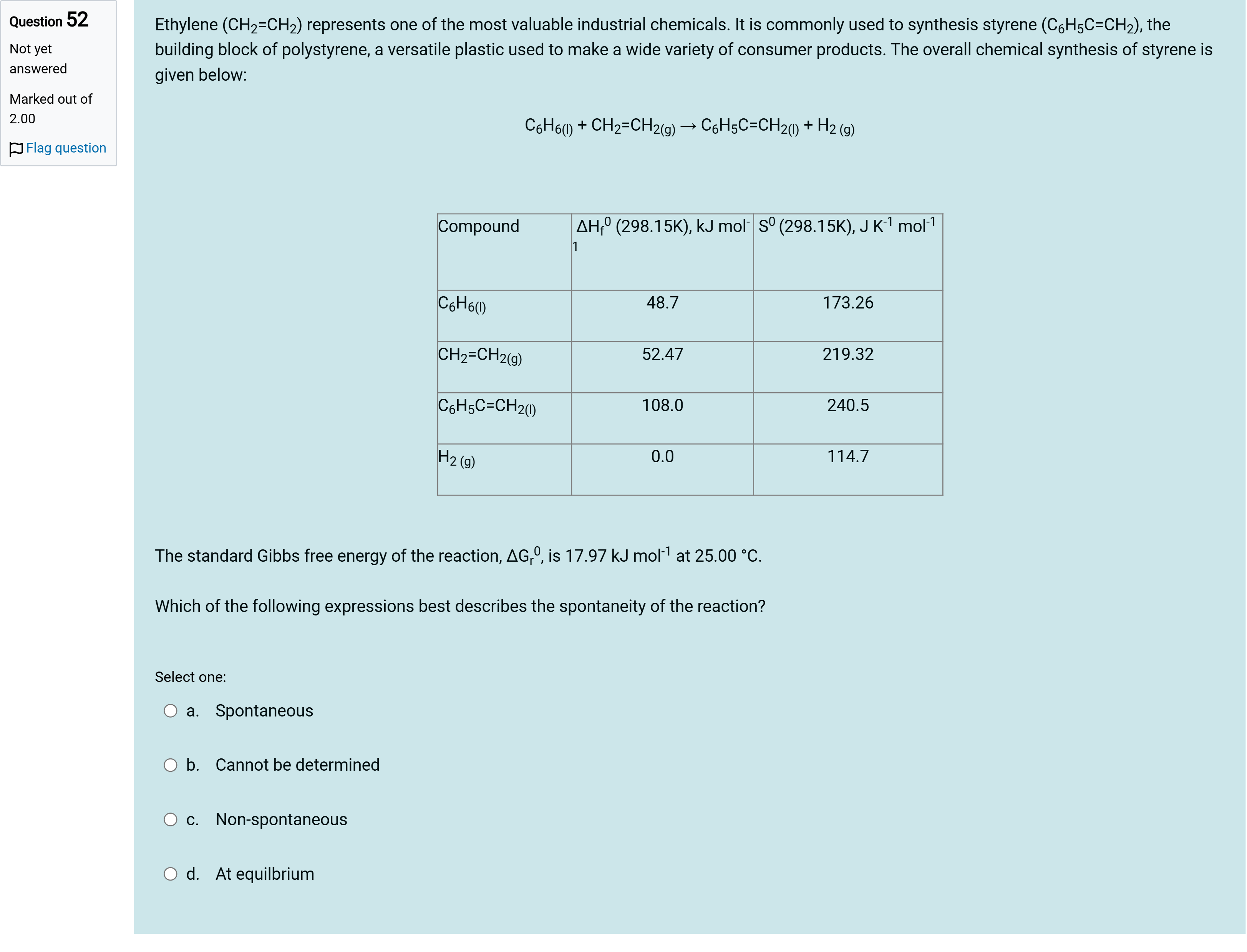
Ethylene (CH2=CH2) represents one of the most valuable industrial chemicals. It is commonly used to synthesis styrene (C6H5C=CH2), the building block of polystyrene, a versatile plastic used to make a wide variety of consumer products. The overall chemical synthesis of styrene is given below: C6H6(l) + CH2=CH2(g) → C6H5C=CH2(l) + H2 (g) [table] Compound | ∆Hf0 (298.15K), kJ mol-1 | S0 (298.15K), J K-1 mol-1 C6H6(l) | 48.7 | 173.26 CH2=CH2(g) | 52.47 | 219.32 C6H5C=CH2(l) | 108.0 | 240.5 H2 (g) | 0.0 | 114.7 [/table] The standard Gibbs free energy of the reaction, ∆Gr0, is 17.97 kJ mol-1 at 25.00 °C. Which of the following expressions best describes the spontaneity of the reaction?
Options
A.a. Spontaneous
B.b. Cannot be determined
C.c. Non-spontaneous
D.d. At equilbrium

View Explanation
Verified Answer
Please login to view
Step-by-Step Analysis
To assess spontaneity, we use the standard Gibbs free energy change ∆G° for the reaction. A negative ∆G° indicates a spontaneous process under standard conditions, while a positive ∆G° indicates non-spontaneity, and ∆G° = 0 would correspond to equilibrium.
Option a: Spontaneous. This would require ∆G° < 0......Login to view full explanationLog in for full answers
We've collected over 50,000 authentic exam questions and detailed explanations from around the globe. Log in now and get instant access to the answers!
Similar Questions
The delta free energy of a reaction is independent of:
Which of the following statements best describes an endergonic reaction?
The reaction, M2O3(s) + C(s) → M(s) + CO2(g), is spontaneous at low temperatures but non-spontaneous at high temperatures. If we assume that, since the physical states do not change, the values of ΔHTo and ΔSTo are constant over a wide temperature range, including 25.0°C, we can deduce that, over this range
Given the data: N2(g), Δf Ho = 0.00 kJ·mol–1, So = +191.5 J·mol–1·K–1H2(g), Δf Ho = 0.00 kJ·mol–1, So = +130.6 J·mol–1·K–1NH3(g), Δf Ho = -46.0 kJ·mol–1, So = +192.5 J·mol–1·K–1 calculate the standard free energy change, ΔGo, for the reaction: N2(g) + 3 H2(g) → 2 NH3(g)
More Practical Tools for International Students
Making Your Study Simpler
Join us and instantly unlock extensive past papers & exclusive solutions to get a head start on your studies!