
题目
单项选择题
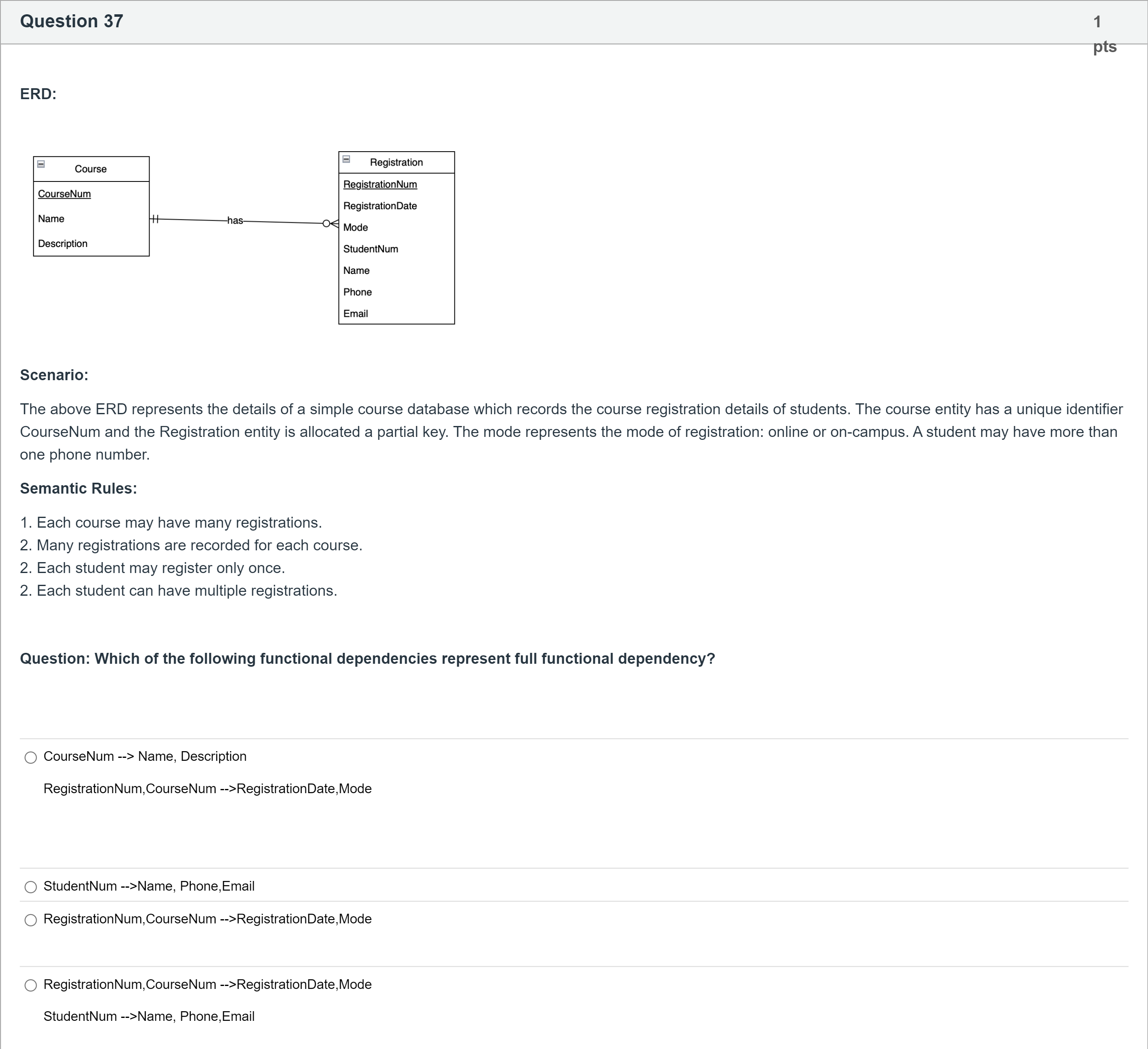
ERD: Scenario: The above ERD represents the details of a simple course database which records the course registration details of students. The course entity has a unique identifier CourseNum and the Registration entity is allocated a partial key. The mode represents the mode of registration: online or on-campus. A student may have more than one phone number. Semantic Rules: 1. Each course may have many registrations. 2. Many registrations are recorded for each course. 2. Each student may register only once. 2. Each student can have multiple registrations. Question: Which of the following functional dependencies represent full functional dependency?
选项
A.CourseNum --> Name, Description
RegistrationNum,CourseNum -->RegistrationDate,Mode
B.StudentNum -->Name, Phone,Email
C.RegistrationNum,CourseNum -->RegistrationDate,Mode
D.RegistrationNum,CourseNum -->RegistrationDate,Mode
StudentNum -->Name, Phone,Email

查看解析
标准答案
Please login to view
思路分析
We start by identifying the concept at play: full functional dependency means that a non-key attribute is functionally determined by the whole candidate key, and not by just part of a composite key. Now, let's examine each option in turn.
Option 1 (A): 'CourseNum --> Name, Description' and 'RegistrationNum,CourseNum --> RegistrationDate, Mode'.
- For the Course relation, CourseNum is the key and determines Name and Description. Since C......Login to view full explanation登录即可查看完整答案
我们收录了全球超50000道考试原题与详细解析,现在登录,立即获得答案。
类似问题
Every time attribute A appears, it is matched with the same value of attribute B, but not the same value of attribute C. Therefore, it is true that:
Using the Entity Relationship Diagram you have drawn on your piece of paper for the Hamilton Island 'BoatRaceResults' Table, answer the following question. Which functional dependency shows a Transitive Dependency in the BoatRaceResults table?
Using the Entity Relationship Diagram you have drawn on your piece of paper for the Hamilton Island 'BoatRaceResults' Table, answer the following question. Which attribute is fully Dependent on the primary key of the BoatRaceResults table?
Using the Entity Relationship Diagram you have drawn on your piece of paper for the Hamilton Island 'BoatRaceResults' Table, answer the following question. Which are Dependent Non-Key Attributes of the BoatRaceResults table?
更多留学生实用工具
希望你的学习变得更简单
加入我们,立即解锁 海量真题 与 独家解析,让复习快人一步!