
Questions
W25 BIOL D006A 02Y Form/Funct In The Biolgcl Wrld Fish Quiz
Matching
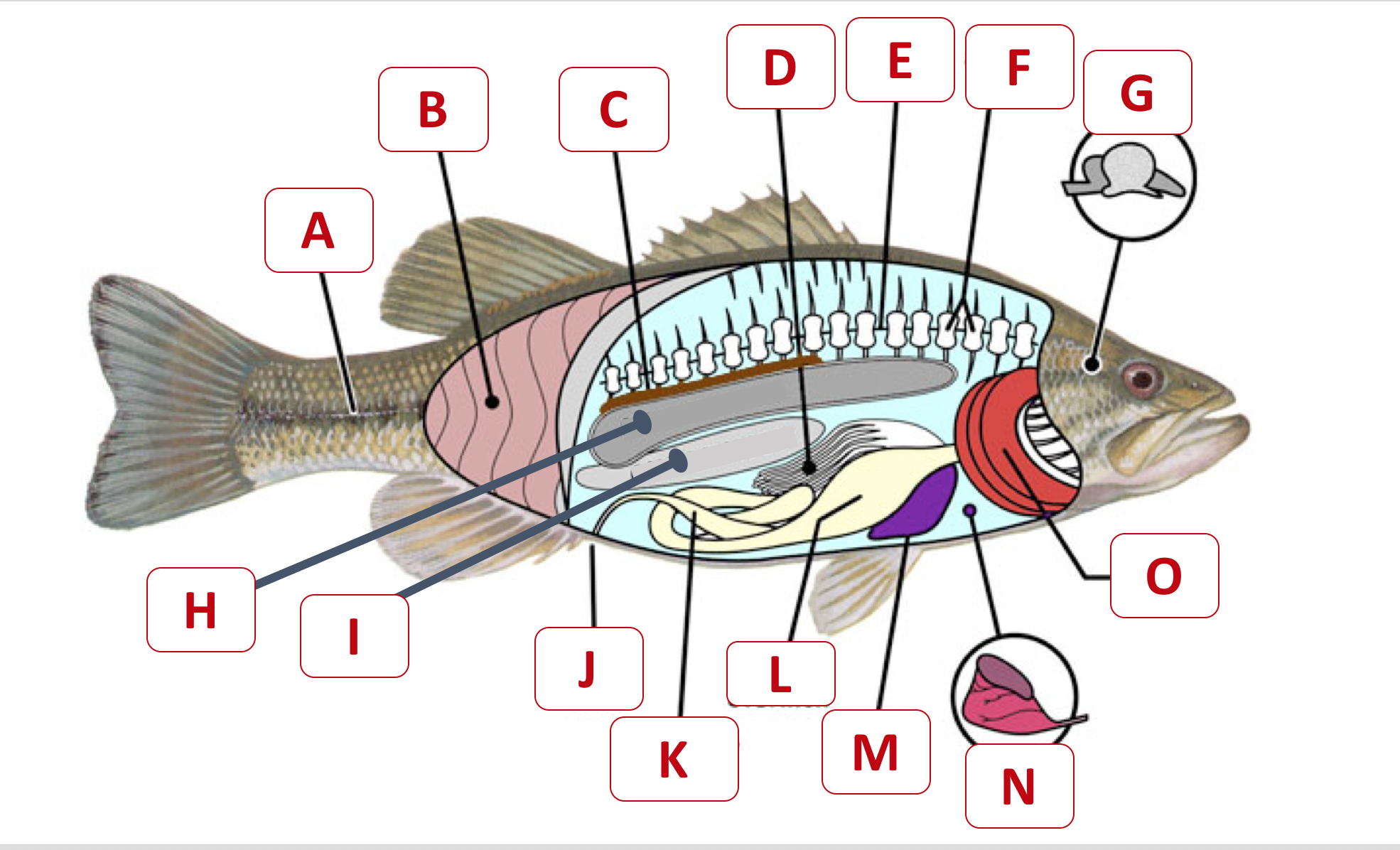
1: anal fin 2: caudal fin 3: caudal peduncle 4: mandible 5: eye 6: fin ray 7: fin spine 8: first dorsal fin 9: lateral line 10: nares 11: operculum 12: pectoral fin 13: pelvic fin 14: scales 15: second dorsal fin 16: vent
Options
A.N
B.C
C.L
D.A
E.G
F.H
G.J
H.F
I.M
J.I
K.E
L.B
M.D
N.K

View Explanation
Verified Answer
Please login to view
Step-by-Step Analysis
Here is a step-by-step analysis of the matching items and their assigned letters. I will evaluate each numbered item against the letter options provided, explaining why a given letter is the correct match or why an alternative would be incorrect.
1) anal fin
- The label mapping given assigns the letter L to item 1. If we cross-check anatomical feature labels in typical fish anatomy, the anal fin is located on the ventral side near the tail, separate from the dorsal fins. The option L corresponds to the correct label for the anal fin in this diagram set, making 1 -> L a correct pairing.
- Other options (N, F, A, etc.) would place the anal fin at incorrect locations or under incorrect anatomical terms, so they do not align with the diagram’s legend for item 1.
2) caudal fin
- The caudal fin is the tail fin. The mapping 2 -> F indicates the label F corresponds to the caudal fin in this figure. This is consistent if F is placed by the tail region in the diagram’s legend.
- Assigning any oth......Login to view full explanationLog in for full answers
We've collected over 50,000 authentic exam questions and detailed explanations from around the globe. Log in now and get instant access to the answers!
Similar Questions
Match the following fish anatomical structure with its function. 1: Exchange oxygen and carbon dioxide with the fish's environment Exchange oxygen and carbon dioxide with the fish's environment 2: Allows fish to maintain equilibrium and stay at any level of water they desire Allows fish to maintain equilibrium and stay at any level of water they desire 3: Provide propulsion and stabilization within the water Provide propulsion and stabilization within the water 4: Sensory organ that detects movement and vibrations in the water Sensory organ that detects movement and vibrations in the water 5: Posterior opening for the digestive, urinary, and reproductive tracts. Posterior opening for the digestive, urinary, and reproductive tracts.
In bony fishes, a protective flap called the covers the gills.
Match the following fish anatomical structure with its function. 1: Exchange oxygen and carbon dioxide with the fish's environment Exchange oxygen and carbon dioxide with the fish's environment 2: Allows fish to maintain equilibrium and stay at any level of water they desire Allows fish to maintain equilibrium and stay at any level of water they desire 3: Provide propulsion and stabilization within the water Provide propulsion and stabilization within the water 4: Sensory organ that detects movement and vibrations in the water Sensory organ that detects movement and vibrations in the water 5: Posterior opening for the digestive, urinary, and reproductive tracts. Posterior opening for the digestive, urinary, and reproductive tracts.
1: brain 2: gills 3: gonad 4: heart 5: Intestine 6: kidney 7: lateral line 8: liver 9: myomere 10: pyloric ceca 11: spinal cord 12: stomach 13: swim bladder 14: cloaca 15: vertebrae
More Practical Tools for Students Powered by AI Study Helper
Making Your Study Simpler
Join us and instantly unlock extensive past papers & exclusive solutions to get a head start on your studies!