
Questions
Matching
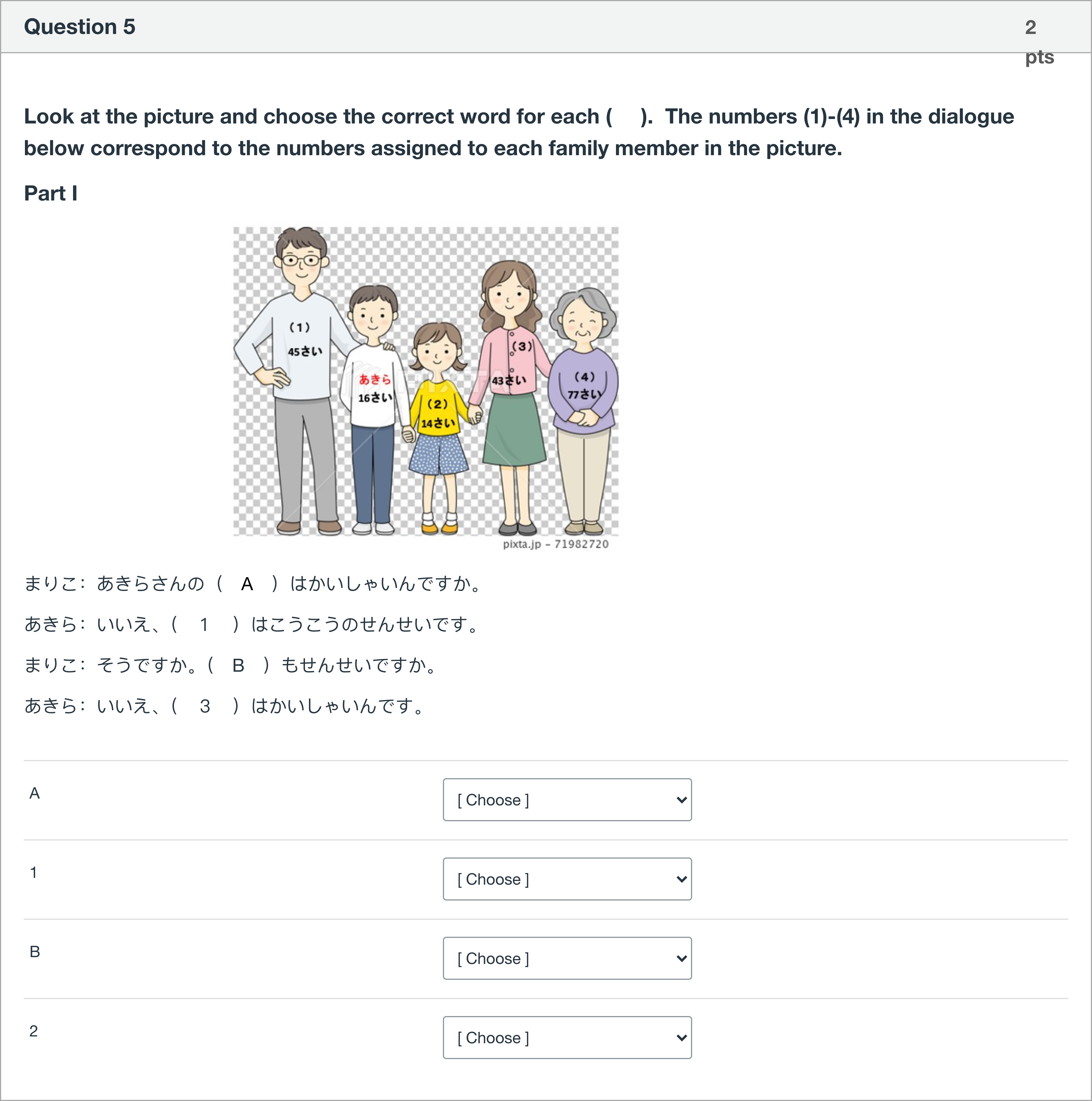
Look at the picture and choose the correct word for each ( ). The numbers (1)-(4) in the dialogue below correspond to the numbers assigned to each family member in the picture. Part I まりこ:あきらさんの( A )はかいしゃいんですか。 あきら:いいえ、( 1 )はこうこうのせんせいです。 まりこ:そうですか。( B )もせんせいですか。 あきら:いいえ、( 3 )はかいしゃいんです。 1: A 2: 1 3: B 4: 2
Options
A.はは
B.ちち
C.おかあさん
D.おとうさん

View Explanation
Verified Answer
Please login to view
Step-by-Step Analysis
Question and options are as follows:
- Question prompt: Look at the picture and choose the correct word for each ( ). The numbers (1)-(4) in the dialogue below correspond to the numbers assigned to each family member in the picture.
- Part I dialogue excerpts include A, 1, B, 3, and 2 placeholders, with the following mappings provided: 1: A, 2: 1, 3: B, 4: 2
- Answer options (the four family-member words to place): ["はは", "ちち", "おかあさん", "おとうさん"]
- Correct answer list (in order for A, 1, B, 2): ["おとうさん", "ちち", "おかあさん", "はは"]
Now, let’s analyze each answer option and what it would mean in the dialogue context.
- Option はは (mother)
- If we place はは for A, the line would read: “まりこ:あきらさんのはははかいしゃいんですか。” This would be an odd repetition, as the possessive would be awkward and less natural in Japanese; typically one would ask about a person’s occupation directly rather than repeating “はは.”
- For 1 (which would become はは or ちち depending on the mapping), you’d be asserting the father or mother’s occupation; using はは for 1 would imply the mother is the high school teacher, which is ......Login to view full explanationLog in for full answers
We've collected over 50,000 authentic exam questions and detailed explanations from around the globe. Log in now and get instant access to the answers!
Similar Questions
位置4的问题 Ini gambar keluarga Patrick. Patrick mempunyai seorang _____________. kakakabangadik lelakiadik perempuan
たろうさんは四人かぞくです。
Based on Lesson 2: A: 请问,你家[Fill in the blank] 几口人? B: 我家有四[Fill in the blank] 人。爸爸,妈妈,姐姐[Fill in the blank] 我。爸爸是律[Fill in the blank] ,妈妈不工[Fill in the blank] 。
You are asking Kaori-san about her family and relatives. How would you address each member of her family? 1: (1) 2: (2) 3: (3) 4: (4)
More Practical Tools for Students Powered by AI Study Helper
Making Your Study Simpler
Join us and instantly unlock extensive past papers & exclusive solutions to get a head start on your studies!