Still overwhelmed by exam stress? You've come to the right place!
We know exam season has you totally swamped. To support your studies, access Gold Membership for FREE until December 31, 2025! Normally £29.99/month. Just Log In to activate – no strings attached.
Let us help you ace your exams efficiently!

Questions
25-1-GEST1008-001_58932 Test ONE
Single choice
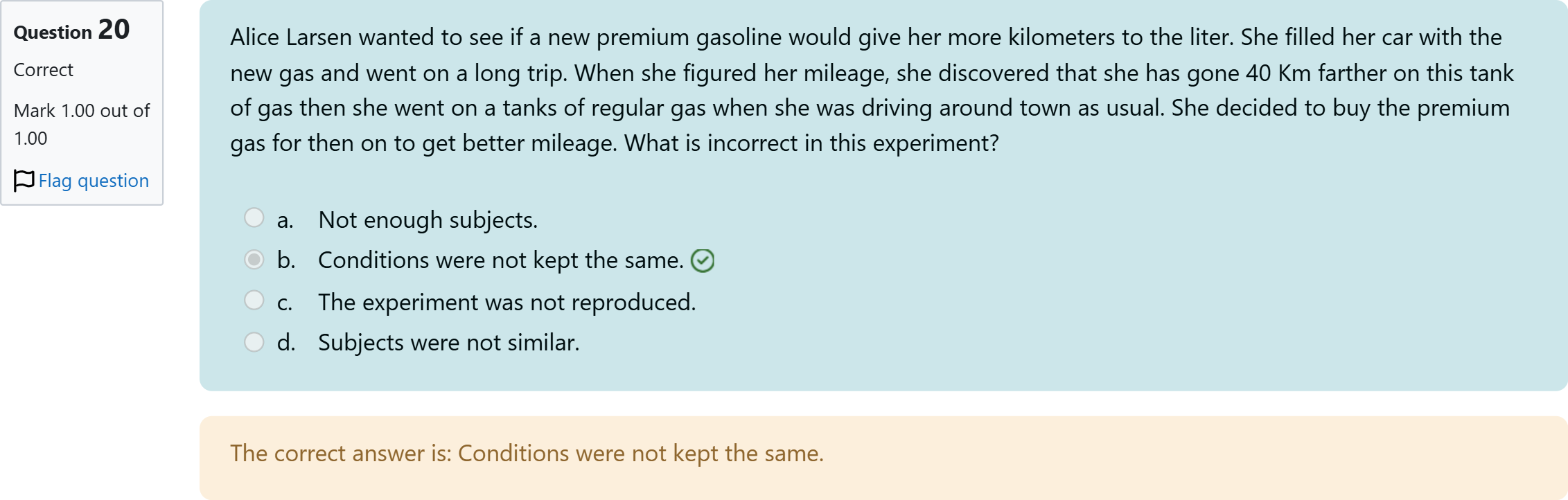
Alice Larsen wanted to see if a new premium gasoline would give her more kilometers to the liter. She filled her car with the new gas and went on a long trip. When she figured her mileage, she discovered that she has gone 40 Km farther on this tank of gas then she went on a tanks of regular gas when she was driving around town as usual. She decided to buy the premium gas for then on to get better mileage. What is incorrect in this experiment?

View Explanation
Standard Answer
Please login to view
Approach Analysis
The scenario presents a detective-like look at a simple experiment comparing mileage between premium and regular gasoline. Each option requires evaluating potential experimental design flaws.
Option a: Not enough subjects. This choice questions sample size. In this particular case, the scenario describes a single car and a single trial (one tank with premium, one with regular). While a small sample size is a valid concern in experiments, the key issue here is not the quantity of subjects or data points but whether the comparis......Login to view full explanationLog in for full answers
We've collected over 50,000 authentic exam questions and detailed explanations from around the globe. Log in now and get instant access to the answers!
Similar Questions
Question at position 15 The key difference between an observational study and an experiment isThe use of random selection of participantsThe number of variables that are being studiedThe ability to replicate the studyThe creation of groups of homogenous subjects to studyThe assignment of treatments to experimental units
Question at position 14 Which of the following is NOT one of the major principles in the design of experiments?All of the given options are important principles of designing experimentsCare in observing without imposing changeRandomization in assigning subjects to different treatmentsControlling for other variablesReplication of the experiment using sufficient numbers of subjects
If you wanted two replicates per treatments, how many experimental units would you need? [ Select ] 8 12 27 x [ Select ] 1 2 3 = [ Select ] 12 24 36 experimental units
Question at position 11 Only two treatments should be used in an experiment.Each shrub did not receive all ten pruning methods.Pruning methods were not randomly assigned to shrubs.Each pruning method was used on only one shrub.The shrubs were not randomly selected.
More Practical Tools for International Students
Making Your Study Simpler
To make preparation and study season easier for more international students, we've decided to open up Gold Membership for a limited-time free trial until December 31, 2025!