Still overwhelmed by exam stress? You've come to the right place!
We know exam season has you totally swamped. To support your studies, access Gold Membership for FREE until December 31, 2025! Normally £29.99/month. Just Log In to activate – no strings attached.
Let us help you ace your exams efficiently!

Questions
CHM1051 MUM S2 2025 CHM1051 Practice Exam 2
Single choice
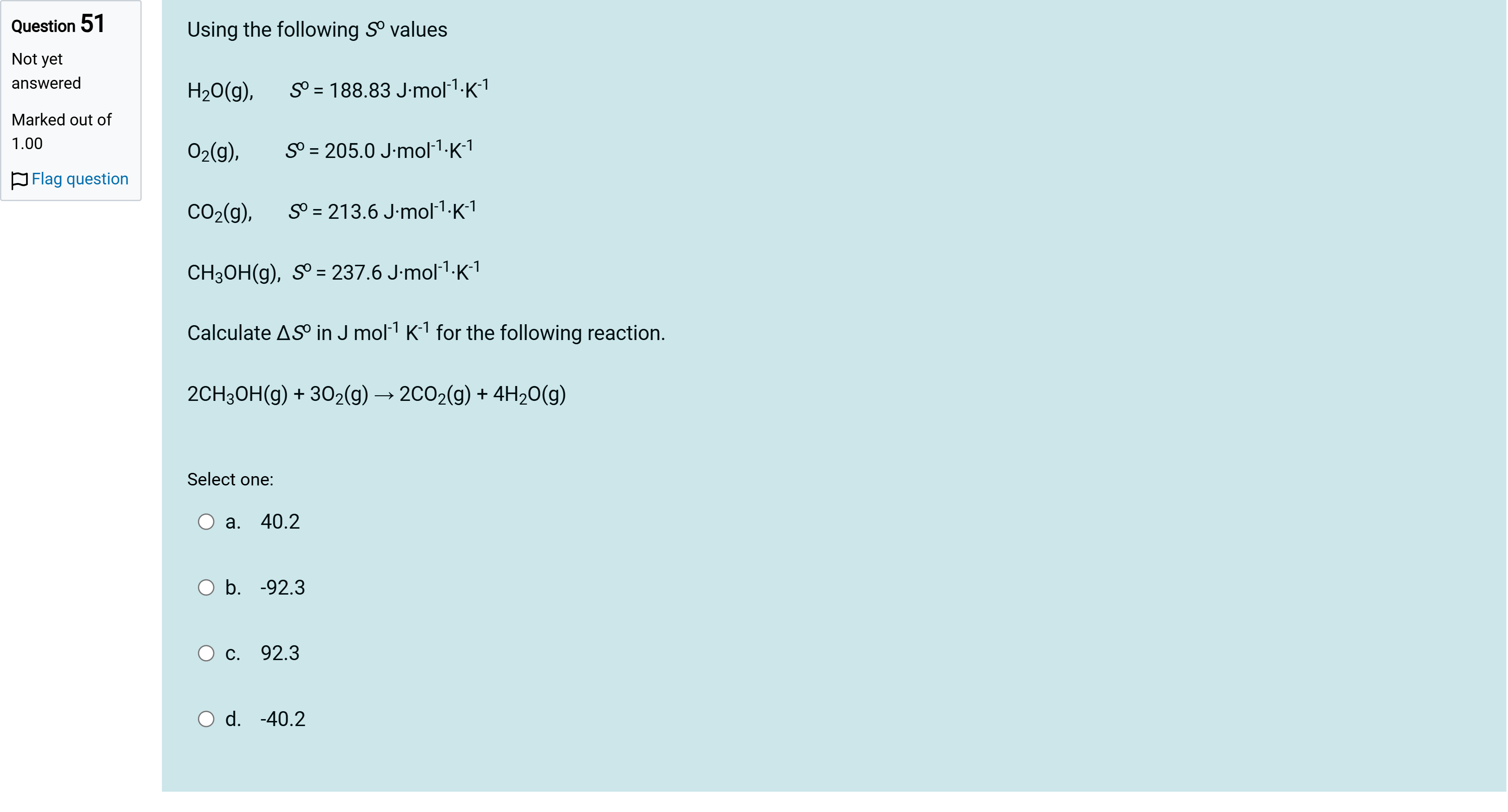
Using the following So values H2O(g), So = 188.83 J·mol-1·K-1 O2(g), So = 205.0 J·mol-1·K-1 CO2(g), So = 213.6 J·mol-1·K-1 CH3OH(g), So = 237.6 J·mol-1·K-1 Calculate ΔSo in J mol-1 K-1 for the following reaction. 2CH3OH(g) + 3O2(g) → 2CO2(g) + 4H2O(g)
Options
A.a. 40.2
B.b. -92.3
C.c. 92.3
D.d. -40.2

View Explanation
Standard Answer
Please login to view
Approach Analysis
To tackle ΔS° for this reaction, begin by listing the standard molar entropies (S°) for each species given: H2O(g) = 188.83 J·mol⁻¹·K⁻¹, O2(g) = 205.0 J·mol⁻¹·K⁻¹, CO2(g) = 213.6 J·mol⁻¹·K⁻¹, CH3OH(g) = 237.6 J·mol⁻¹·K⁻¹. The reaction is: 2 CH3OH(g) + 3 O2(g) → 2 CO2(g) + 4 H2O(g).
Step 1: Compute total S° for products. There are 2 moles of CO2 and 4 moles of H2O.
- S° ......Login to view full explanationLog in for full answers
We've collected over 50,000 authentic exam questions and detailed explanations from around the globe. Log in now and get instant access to the answers!
Similar Questions
Calculate the value of S° for the reaction shown: 2 NH3(g) N2(g) + 3 H2(g) At 25°C the values of entropy in J K−1 mol−1 are ammonia, 192.77; nitrogen, 191.61; and hydrogen, 130.68.
Propanol (C3H8O) has a boiling point of 97.0 ºC and ΔHvap =42.27 kJ mol-1. Calculate ΔS for the process given below. CH3CH2CH2OH (l) → CH3CH2CH2OH (g)
Using the following So values H2O(g), So = 188.83 J·mol-1·K-1 O2(g), So = 205.0 J·mol-1·K-1 CO2(g), So = 213.6 J·mol-1·K-1 CH3OH(g), So = 237.6 J·mol-1·K-1 Calculate ΔSo in J mol-1 K-1 for the following reaction. 2CH3OH(g) + 3O2(g) → 2CO2(g) + 4H2O(g)
Ethylene (CH2=CH2) represents one of the most valuable industrial chemicals. It is commonly used to synthesis styrene (C6H5C=CH2), the building block of polystyrene, a versatile plastic used to make a wide variety of consumer products. The overall chemical synthesis of styrene is given below: C6H6(l) + CH2=CH2(g) → C6H5C=CH2(l) + H2 (g) [table] Compound | ∆Hf0 (298.15K), kJ mol-1 | S0 (298.15K), J K-1 mol-1 C6H6(l) | 48.7 | 173.26 CH2=CH2(g) | 52.47 | 219.32 C6H5C=CH2(l) | 108.0 | 240.5 H2 (g) | 0.0 | 114.7 [/table] What should happen to the entropy of the system during the reaction?
More Practical Tools for International Students
Making Your Study Simpler
To make preparation and study season easier for more international students, we've decided to open up Gold Membership for a limited-time free trial until December 31, 2025!