
Questions
BIO 181 (001&002) FALL 2025 FA25: Exam 3: Phylogeny & Biodiversity (Breathe in, breath out)
Single choice
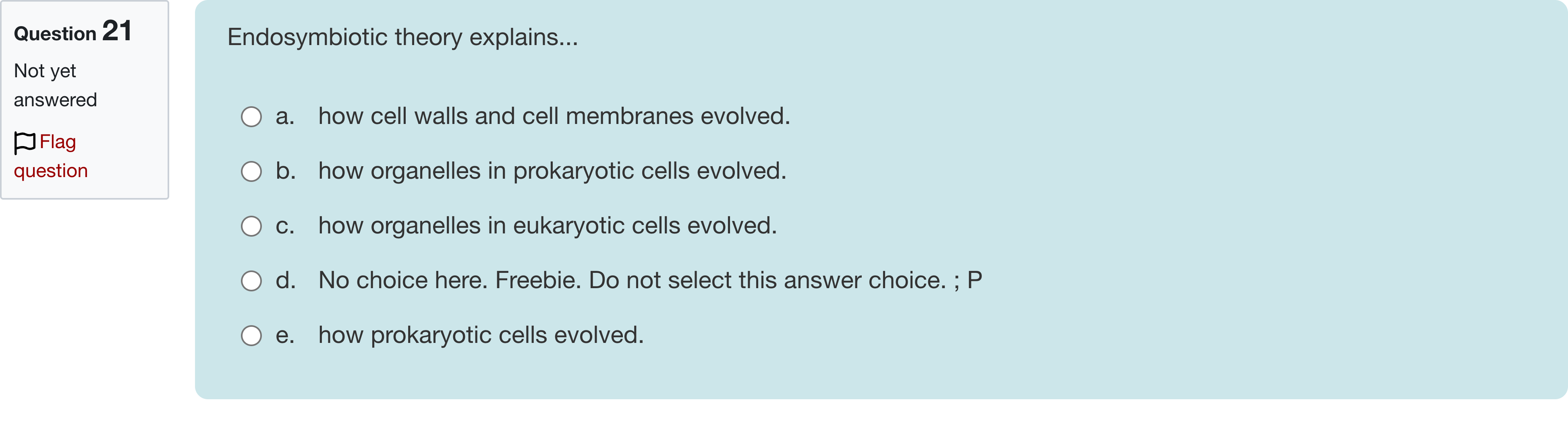
Endosymbiotic theory explains...
Options
A.a. how cell walls and cell membranes evolved.
B.b. how organelles in prokaryotic cells evolved.
C.c. how organelles in eukaryotic cells evolved.
D.d. No choice here. Freebie. Do not select this answer choice. ; P
E.e. how prokaryotic cells evolved.

View Explanation
Verified Answer
Please login to view
Step-by-Step Analysis
Question: Endosymbiotic theory explains...
Option a: how cell walls and cell membranes evolved. This is not the central claim of the endosymbiotic theory. Cell walls and membranes involve abiotic components and structural elements of cells, not the origin of organelles through symbiotic events. Therefore this option misattributes the theory to a broader or unrelated aspect of cellular structure.
Option b: how organelles in prokaryotic ......Login to view full explanationLog in for full answers
We've collected over 50,000 authentic exam questions and detailed explanations from around the globe. Log in now and get instant access to the answers!
Similar Questions
Ancestors of which type of bacteria likely gave rise to chloroplasts?
Question at position 8 The endosymbiotic theory for the origin of mitochondria and chloroplasts suggests that these organelles arose from prokaryotic organisms that took up residence within an ancestral pre-eukaryotic cell. Which of the following statements offered in support of this theory is FALSE?Mitochondria and chloroplasts have circular chromosomes.Mitochondria, chloroplasts, and prokaryotes are similar in size.Mitochondria and chloroplasts have nuclei like other prokaryotes.Mitochondria and chloroplasts multiple by binary fission, like other prokaryotes.Clear my selection
Question at position 15 The endosymbiotic theory for the origin of mitochondria and chloroplasts suggests that these organelles arose from prokaryotic organisms that took up residence within an ancestral pre-eukaryotic cell. Which of the following statements offered in support of this theory is FALSE?Mitochondria and chloroplasts have circular chromosomes.Mitochondria and chloroplasts multiple by binary fission, like other prokaryotes.Mitochondria and chloroplasts have nuclei like other prokaryotes.Mitochondria, chloroplasts, and prokaryotes are similar in size.Clear my selection
Question at position 29 What evidence indicates mitochondria evolved before chloroplasts in eukaryotic cells?Chloroplasts can reproduce independently, while mitochondria cannot.Mitochondria are larger and more complex than chloroplasts.All eukaryotes have mitochondria, but only some groups have chloroplasts.Mitochondria contain linear chromosomes, whereas chloroplasts have circular chromosomes.Clear my selection
More Practical Tools for Students Powered by AI Study Helper
Making Your Study Simpler
Join us and instantly unlock extensive past papers & exclusive solutions to get a head start on your studies!