
Questions
Single choice
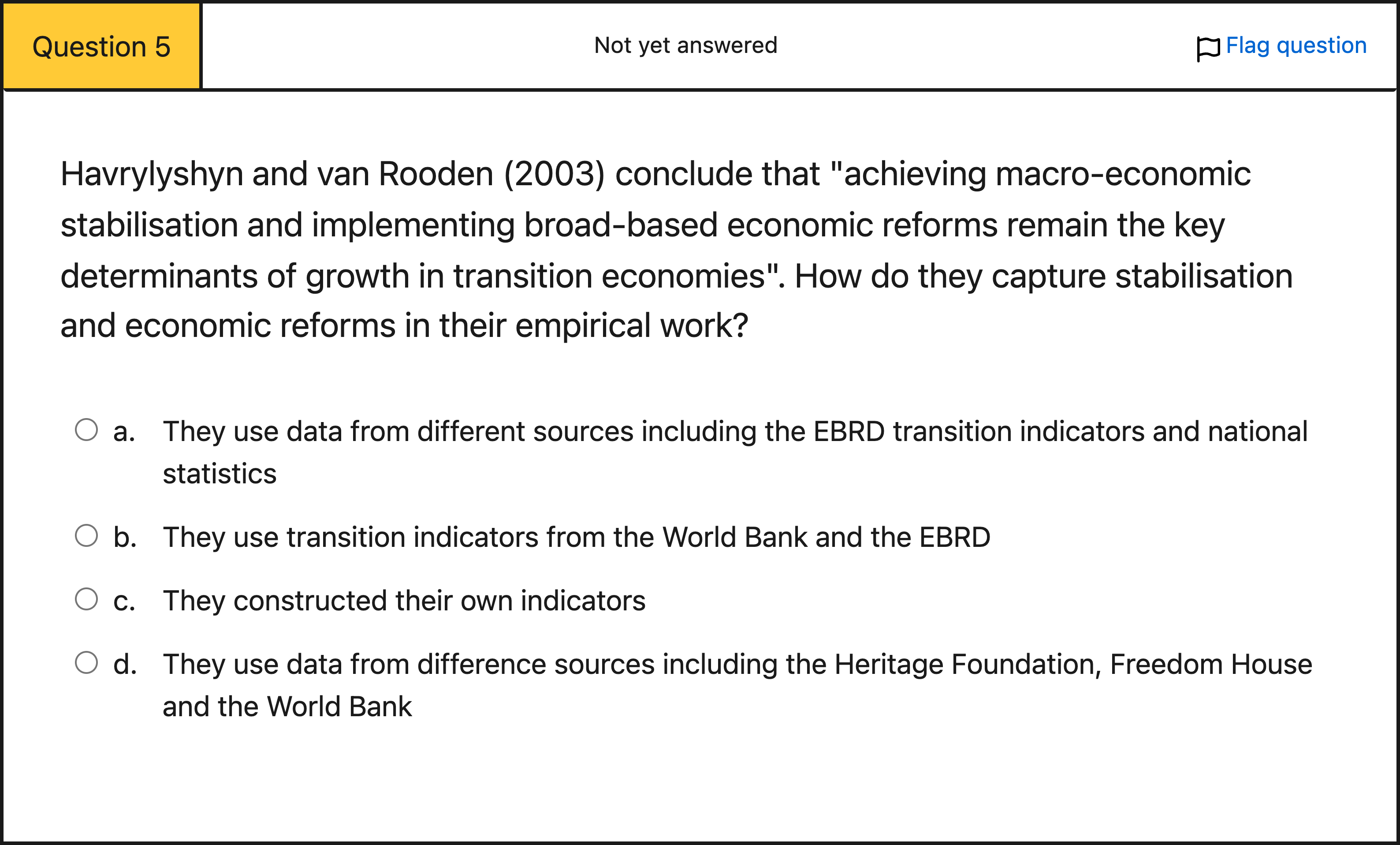
Havrylyshyn and van Rooden (2003) conclude that "achieving macro-economic stabilisation and implementing broad-based economic reforms remain the key determinants of growth in transition economies". How do they capture stabilisation and economic reforms in their empirical work?
Options
A.a. They use data from different sources including the EBRD transition indicators and national statistics
B.b. They use transition indicators from the World Bank and the EBRD
C.c. They constructed their own indicators
D.d. They use data from difference sources including the Heritage Foundation, Freedom House and the World Bank

View Explanation
Verified Answer
Please login to view
Step-by-Step Analysis
Question restated: Havrylyshyn and van Rooden (2003) conclude that 'achieving macro-economic stabilisation and implementing broad-based economic reforms remain the key determinants of growth in transition economies'. How do they capture stabilisation and economic reforms in their empirical work?
Option a: They use data from different sources including the EBRD transition indicators and national statistics. This option is partly plausible because empirical work often relies on multiple sources, including national statistic......Login to view full explanationLog in for full answers
We've collected over 50,000 authentic exam questions and detailed explanations from around the globe. Log in now and get instant access to the answers!
Similar Questions
Which of following is NOT broadly considered as one of the three fundamental processes of Chinese economic reforms since late 1970s?
The mainstream of development economists has collectively summarised three secrets behind tremendous success of China’s economic and opening-up reforms since 1978, including marketisation, de-centralisation and globalisation. Which following specific reform is least related to ‘globalisation’?
Which of the following best characterizes China's approach to economic reforms that began in the late 1970s?
Which factor most significantly accounts for the contrasting outcomes of market liberalization between post-Soviet Russia and post-Mao China?
More Practical Tools for International Students
Making Your Study Simpler
Join us and instantly unlock extensive past papers & exclusive solutions to get a head start on your studies!