
Questions
BIO 181 (001&002) FALL 2025 FA25: Cumulative Exam 4 covers the most important content from Units 1-4: You can do this!!! : ) [Grade is out of 150/900 pts, the same am't of pts for the active learning "easy points" classwork.]
Single choice
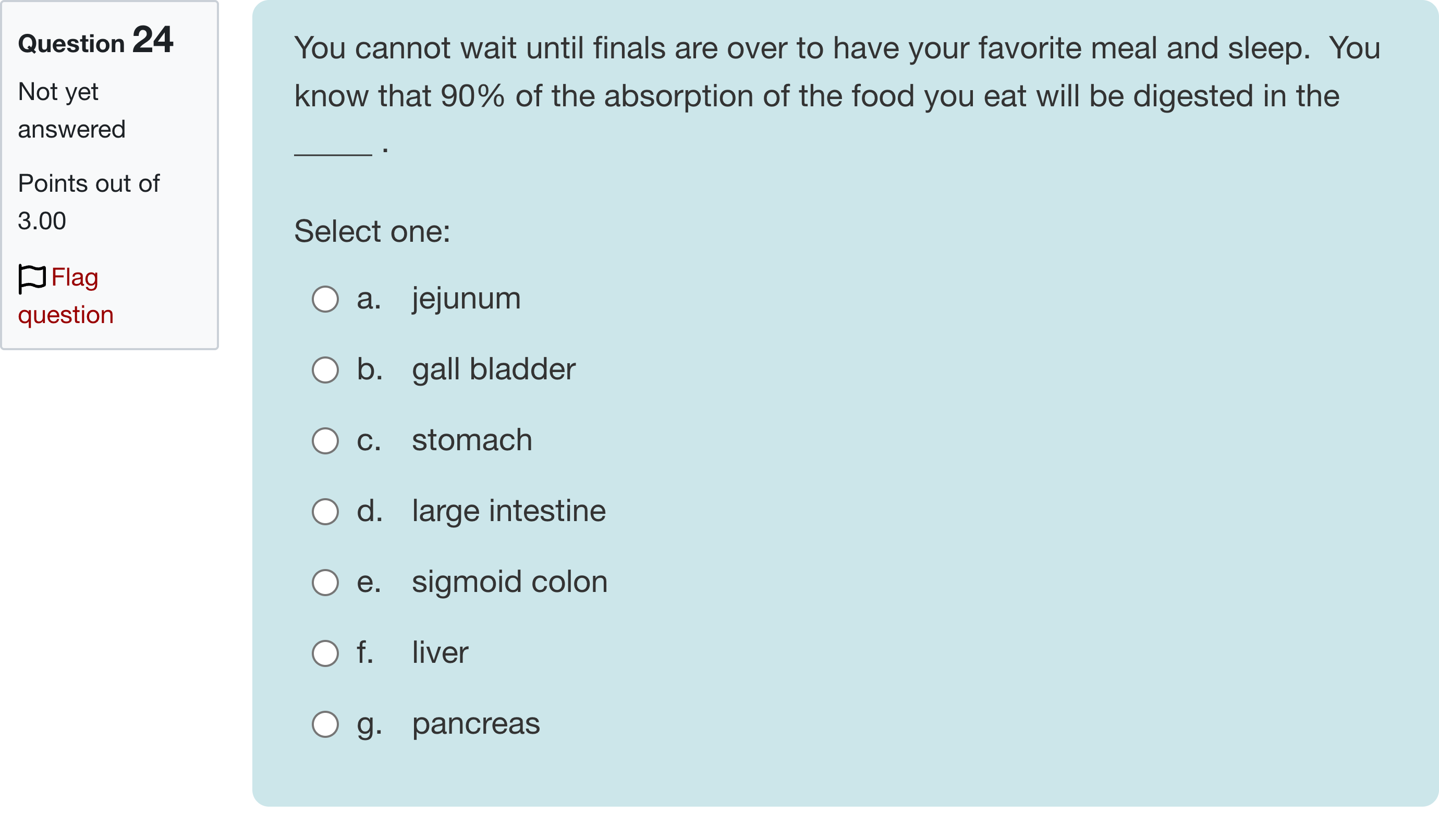
You cannot wait until finals are over to have your favorite meal and sleep. You know that 90% of the absorption of the food you eat will be digested in the _____ .
Options
A.a. jejunum
B.b. gall bladder
C.c. stomach
D.d. large intestine
E.e. sigmoid colon
F.f. liver
G.g. pancreas

View Explanation
Verified Answer
Please login to view
Step-by-Step Analysis
The question asks where 90% of the absorption of the food you eat will be digested.
Option a: jejunum. This is the correct site for most nutrient absorption in the small intestine; the jejunum has a large surface area due to villi and microvilli, making it the primary region for absorbing sugars, amino acids, ......Login to view full explanationLog in for full answers
We've collected over 50,000 authentic exam questions and detailed explanations from around the globe. Log in now and get instant access to the answers!
Similar Questions
The majority of digestion and absorption occurs in the
Complete the table describing the digestion and absorption process in each part of the gastrointestinal tract, and the destination of the digestion products. Nutrient Mouth Stomach Small intestine Destination Protein [ Select ] Mechanical breakdown Chemical breakdown [ Select ] Proteases break polypeptides into amino acids Free fatty acids in miscelles form Mechanical breakdown Pepsin breaks proteins into polypeptides [ Select ] Proteases break polypeptides into amino acids, dipeptides and tripeptides Acid denatures proteins [ Select ] Short chain fatty acids diffuse into blood vessels Amino acids and small peptides enter blood vessels Monosaccharides enter blood vessels Carbohydrates Mechanical breakdown Salivary amylase starts to break down polysaccharides into disaccharides [ Select ] Chemical breakdown Mechanical breakdown [ Select ] Proteases break polypeptides into amino acids, dipeptides and tripeptides Pancreatic amylase breaks polysaccharides & oligosaccharides into disaccharides Pancreatic lipase breaks triglycerides into monoglycerides and fatty acids [ Select ] Short chain fatty acids diffuse into blood vessels Monosaccharides enter blood vessels Amino acids and small peptides enter blood vessels Lipid Mechanical breakdown [ Select ] Mechanical breakdown Chemical breakdown [ Select ] Pancreatic amylase breaks polysaccharides & oligosaccharides into disaccharides Proteases break polypeptides into amino acids, dipeptides and tripeptides Bile salts emulsify lipids into smaller droplets. Pancreatic lipase breaks triglycerides into monoglycerides and fatty acids Bile salts form these into micelles [ Select ] Monosaccharides enter blood vessels Short chain fatty acids diffuse into blood vessels Amino acids and small peptides enter blood vessels
Complete the table describing the digestion and absorption process in each part of the gastrointestinal tract, and the destination of the digestion products. Nutrient Mouth Stomach Small intestine Destination Protein [ Select ] Mechanical breakdown Chemical breakdown [ Select ] Mechanical breakdown Pepsin breaks proteins into polypeptides Free fatty acids in miscelles form Proteases break polypeptides into amino acids [ Select ] Acid denatures proteins Proteases break polypeptides into amino acids, dipeptides and tripeptides [ Select ] Short chain fatty acids diffuse into blood vessels Monosaccharides enter blood vessels Amino acids and small peptides enter blood vessels Carbohydrates Mechanical breakdown Salivary amylase starts to break down polysaccharides into disaccharides [ Select ] Chemical breakdown Mechanical breakdown [ Select ] Proteases break polypeptides into amino acids, dipeptides and tripeptides Pancreatic amylase breaks polysaccharides & oligosaccharides into disaccharides Pancreatic lipase breaks triglycerides into monoglycerides and fatty acids [ Select ] Short chain fatty acids diffuse into blood vessels Amino acids and small peptides enter blood vessels Monosaccharides enter blood vessels Lipid Mechanical breakdown [ Select ] Mechanical breakdown Chemical breakdown [ Select ] Proteases break polypeptides into amino acids, dipeptides and tripeptides Pancreatic amylase breaks polysaccharides & oligosaccharides into disaccharides Bile salts emulsify lipids into smaller droplets. Pancreatic lipase breaks triglycerides into monoglycerides and fatty acids Bile salts form these into micelles [ Select ] Monosaccharides enter blood vessels Amino acids and small peptides enter blood vessels Short chain fatty acids diffuse into blood vessels
Complete the table describing the digestion and absorption process in each part of the gastrointestinal tract, and the destination of the digestion products. Nutrient Mouth Stomach Small intestine Destination Protein [ Select ] Mechanical breakdown Chemical breakdown [ Select ] Free fatty acids in miscelles form Pepsin breaks proteins into polypeptides Mechanical breakdown Proteases break polypeptides into amino acids [ Select ] Acid denatures proteins Proteases break polypeptides into amino acids, dipeptides and tripeptides [ Select ] Amino acids and small peptides enter blood vessels Monosaccharides enter blood vessels Short chain fatty acids diffuse into blood vessels Carbohydrates Mechanical breakdown Salivary amylase starts to break down polysaccharides into disaccharides [ Select ] Chemical breakdown Mechanical breakdown [ Select ] Proteases break polypeptides into amino acids, dipeptides and tripeptides Pancreatic lipase breaks triglycerides into monoglycerides and fatty acids Pancreatic amylase breaks polysaccharides & oligosaccharides into disaccharides [ Select ] Monosaccharides enter blood vessels Short chain fatty acids diffuse into blood vessels Amino acids and small peptides enter blood vessels Lipid Mechanical breakdown [ Select ] Chemical breakdown Mechanical breakdown [ Select ] Pancreatic amylase breaks polysaccharides & oligosaccharides into disaccharides Bile salts emulsify lipids into smaller droplets. Pancreatic lipase breaks triglycerides into monoglycerides and fatty acids Bile salts form these into micelles Proteases break polypeptides into amino acids, dipeptides and tripeptides [ Select ] Amino acids and small peptides enter blood vessels Monosaccharides enter blood vessels Short chain fatty acids diffuse into blood vessels
More Practical Tools for Students Powered by AI Study Helper
Making Your Study Simpler
Join us and instantly unlock extensive past papers & exclusive solutions to get a head start on your studies!