
Questions
FA25_QTM_110_1 Quiz #8: Difference in Differences
True/False
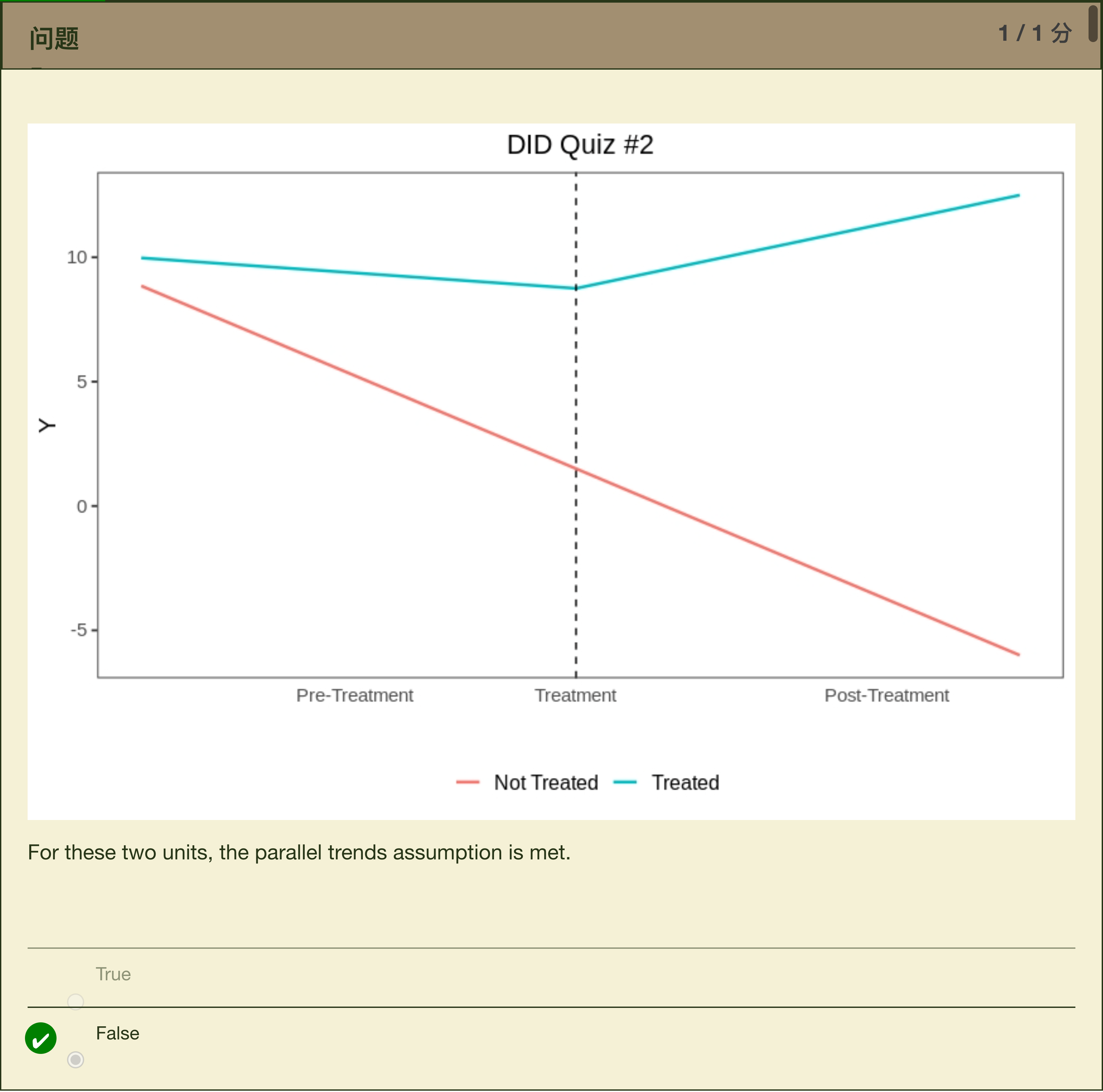
For these two units, the parallel trends assumption is met.

View Explanation
Verified Answer
Please login to view
Step-by-Step Analysis
To begin, consider what the parallel trends assumption means in a DID or comparative study: prior to the treatment, the treated and control groups should exhibit similar trends in the outcome over time, i.e., their trajectories should be roughly parallel.
Option: True — The clai......Login to view full explanationLog in for full answers
We've collected over 50,000 authentic exam questions and detailed explanations from around the globe. Log in now and get instant access to the answers!
Similar Questions
位置6的问题 Difference-in-differences is only valid when treated and untreated units have identical values for observable pre-treatment features.TrueFalseDon't Know清除选择
Select all of the statements that are true about Difference-In-Differences research designs:
Assuming that the unobserved potential outcome for the treated unit would have continued smoothly and predictably after the treatment time (e.g. the line would have continued as it was before treatment time), we expect that the estimate produced by the DID estimator for this example overestimates the true treatment effect for the treated unit.
The estimate produced by the DiD estimator in this example is:
More Practical Tools for Students Powered by AI Study Helper
Making Your Study Simpler
Join us and instantly unlock extensive past papers & exclusive solutions to get a head start on your studies!