
Questions
BU.330.770.T2.FA25 Quiz 1- Requires Respondus LockDown Browser
Single choice
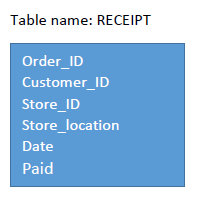
Examine the following table and decide how to make it conform to the rule of the 2nd Normal Form: The business has 30 stores in MD and DC. Order_IDs (Primary Key) are generated uniquely and sequentially across the 30 stores. For example, an Order_ID value of '000011' is unique across all stores and customers.
Options
A.Delete the attribute 'Store_ID'
B.Nothing, it's already in 2NF.
C.Move the attributes 'Customer_ID' and 'Store_ID' to create a bridging entity
D.Move the attributes 'Store_ID' and 'Store_location' to a new table, STORE, and create a relationship between the RECEIPT table and the STORE table

View Explanation
Verified Answer
Please login to view
Step-by-Step Analysis
To evaluate how to bring the RECEIPT table into 2NF, we first restate what the table contains and what 2NF requires. The RECEIPT table shows Order_ID (PK), Customer_ID, Store_ID, Store_location, Date, Paid. The potential issue is a transitive dependency: Store_location is dependent on Store_ID, but Store_ID is not part of the primary key, so a non-key attribute (Store_location) depends on another non-key via Store_ID.
Option A: Delete the attribute 'Store_ID'. By remo......Login to view full explanationLog in for full answers
We've collected over 50,000 authentic exam questions and detailed explanations from around the globe. Log in now and get instant access to the answers!
Similar Questions
What would be the best normalised relational model for the Entity E? Entity: E (A, B, C, D) Functional Dependencies : A, B → C, D C → B
What is the highest Normal Form of the following table? Each Girl can grow more than one Flower and lives at one Address.
What is the highest Normal Form of the following table? Each Owner can own one or more PetTypes. Each PetType may have one or more Owners. Each Owner has one Address and one Phone Number
What is the highest Normal Form of the following table? Table: Products ( Pnum, Factory , Cost, On_Hand, Colour ) Business rules state that:- No colour is produced by more than one factory and A factory can produce more than one colour. Functional Dependencies Pnum, Factory → Cost, On_Hand, Colour Colour → Factory
More Practical Tools for Students Powered by AI Study Helper
Making Your Study Simpler
Join us and instantly unlock extensive past papers & exclusive solutions to get a head start on your studies!