
Questions
Single choice
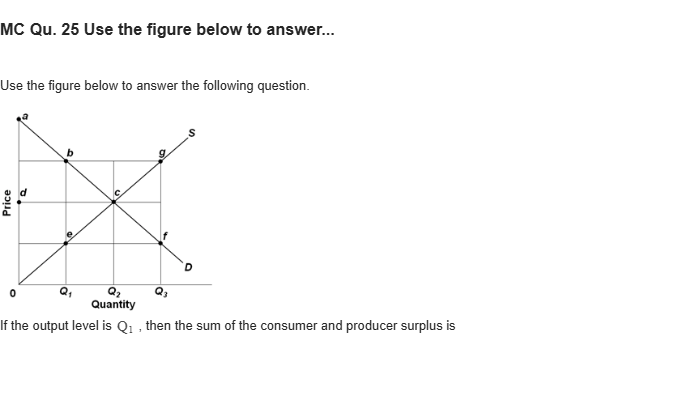
MC Qu. 25 Use the figure below to answer... Use the figure below to answer the following question. The horizontal axis lists labels from left to right as Q1, Q2, and Q3. A decreasing line from a point a at the vertical axis is labeled upper D and intersects an increasing line from the origin, labeled S, forming one triangle each, along both the vertical and horizontal axes. The point of intersection of S and D is labeled c and connects to the horizontal axis at Q2 and vertical axis at a point labeled lower d. A line from a point labeled b, at upper D to Q1 intersects S at a point labeled e. A dotted line from a point, g at S to Q3 intersects D at a point labeled f. All the labeled points are connected to both the axes through dotted straight lines. If the output level is Q 1 Q 1 , then the sum of the consumer and producer surplus is
Options
A.0ac.
B.bce.
C.0
eQ
1
0
eQ
1
.
D.0abe.

View Explanation
Verified Answer
Please login to view
Step-by-Step Analysis
The question asks: If the output level is Q1, then the sum of the consumer and producer surplus is ...
First, I restate the core pieces of the problem from the prompt to orient the analysis: we have a supply and demand diagram with labeled points a, b, c, d, e, f, g, and lines forming various triangles and intersections on a graph with quantity axes Q1, Q2, Q3. The output level is given as Q1. The multiple-choice options provided are garbled strings: 0ac., bce., 0
eQ
1
0
eQ
1
., and 0abe.
Option-by-option evaluation can proceed as follows:
- Option labeled as 0ac.: This choice seems to be a concatenation of characters and does not form a readable description of a numerical or algebraic expression for surplus. Because monetary surplus values in these diagrams are typically expressed as a positive a......Login to view full explanationLog in for full answers
We've collected over 50,000 authentic exam questions and detailed explanations from around the globe. Log in now and get instant access to the answers!
Similar Questions
The sum of consumer surplus and producer surplus is equal to
According to the lecture, economic welfare or value created represents:
Consider a perfectly competitive market at equilibrium. The equilibrium price defines
Amanda buys a ruby for $330 for which she was willing to pay $340. The minimum acceptable price to the seller, Tony, was $140. Tony experiences a
More Practical Tools for Students Powered by AI Study Helper
Making Your Study Simpler
Join us and instantly unlock extensive past papers & exclusive solutions to get a head start on your studies!