
Questions
FFP001 Skills and Content Test 2 | LA044- Requires Respondus LockDown Browser
Short answer
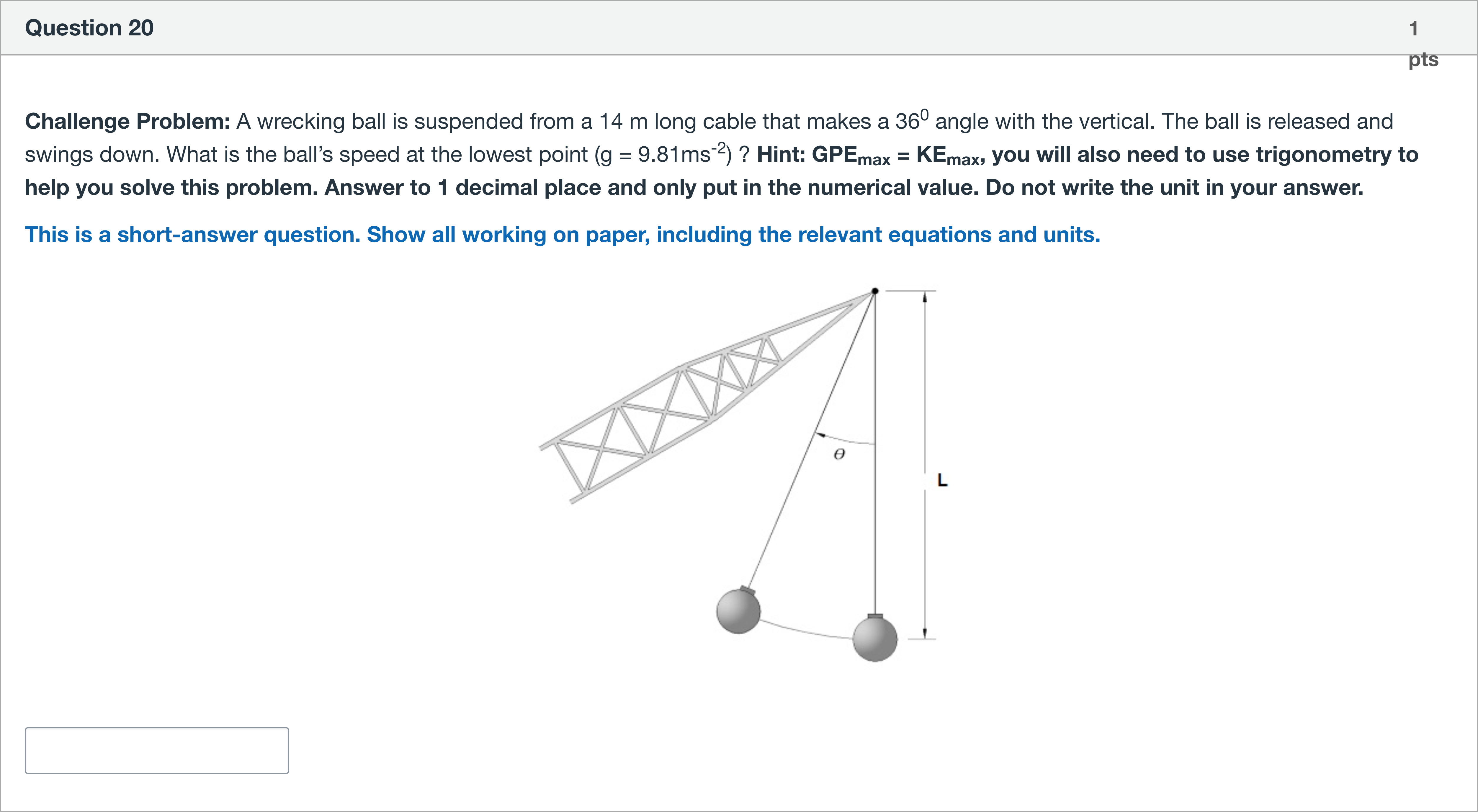
Challenge Problem: A wrecking ball is suspended from a 14 m long cable that makes a 360 angle with the vertical. The ball is released and swings down. What is the ball’s speed at the lowest point (g = 9.81ms-2) ? Hint: GPEmax = KEmax, you will also need to use trigonometry to help you solve this problem. Answer to 1 decimal place and only put in the numerical value. Do not write the unit in your answer. This is a short-answer question. Show all working on paper, including the relevant equations and units.

View Explanation
Verified Answer
Please login to view
Step-by-Step Analysis
First, I restate the problem to ensure understanding: a wrecking ball is suspended from a 14 m long cable, the cable makes a 36° angle with the vertical, the ball is released and swings to the lowest point, and we’re to find its speed at the bottom using g = 9.81 m/s^2. The hint tells us GPEmax = KEmax, and that trigonometry will be needed.
Step 1: Identify the energy conversion. At the highest point (initial release) the ball has gravitational potenti......Login to view full explanationLog in for full answers
We've collected over 50,000 authentic exam questions and detailed explanations from around the globe. Log in now and get instant access to the answers!
Similar Questions
What should the height of a slide in a park be so that a child will reach the bottom of the slide with a speed of 15.0 m/s? Use g = 10.0 m/s2.
A simple pendulum of length 2.00 m is made with a mass of 2.00 kg. The mass has a speed of 3.00 m/s when the pendulum is 30.0° above its lowest position. What is the maximum angle (in degrees) away from the lowest position the pendulum will reach?
A ball can be rolled down one of four different ramps, as shown below. The final elevation loss of each of the ramps is the same. Neglecting friction, for which ramp will the speed of the ball be the highest at the bottom?
A 0.30kg soccer ball is released from the top of a 10m building. The ball strikes the ground with a speed of 12m/s. Use the conservation of energy to determine the energy lost due to the work done by air resistance.
More Practical Tools for Students Powered by AI Study Helper
Making Your Study Simpler
Join us and instantly unlock extensive past papers & exclusive solutions to get a head start on your studies!