
Questions
Multiple fill-in-the-blank
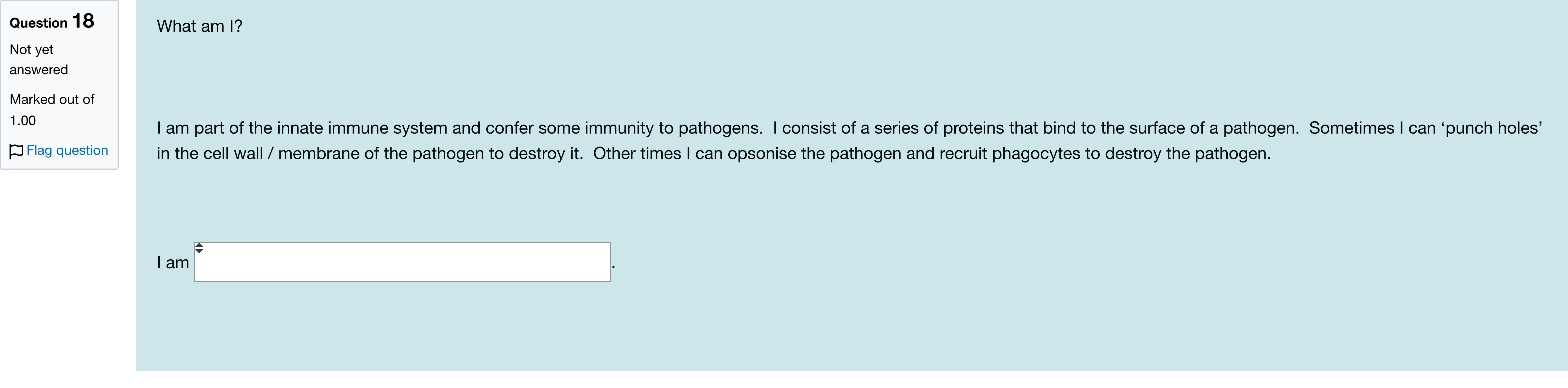
Question textWhat am I? I am part of the innate immune system and confer some immunity to pathogens. I consist of a series of proteins that bind to the surface of a pathogen. Sometimes I can ‘punch holes’ in the cell wall / membrane of the pathogen to destroy it. Other times I can opsonise the pathogen and recruit phagocytes to destroy the pathogen. I am Answer 1 Question 18[select: , A pathogen associated molecular pattern (PAMP), A B cell, The complement system, A pathogen recognition receptor (PRR), An antibody].

View Explanation
Verified Answer
Please login to view
Step-by-Step Analysis
Here is the analysis of each option in the context of the described innate immune component.
Option 1: A pathogen-associated molecular pattern (PAMP). A PAMP is a molecular signature found on pathogens that is recognized by the immune system, not a component that directly performs actions like punching holes or opsonizing. So this choice misidentifies the effector mechanism described.
Option 2: A B cell. B cells......Login to view full explanationLog in for full answers
We've collected over 50,000 authentic exam questions and detailed explanations from around the globe. Log in now and get instant access to the answers!
Similar Questions
The complement system refers to:
Question textWhat am I? I am part of the innate immune system and confer some immunity to pathogens. I consist of a series of proteins that bind to the surface of a pathogen. Sometimes I can ‘punch holes’ in the cell wall / membrane of the pathogen to destroy it. Other times I can opsonise the pathogen and recruit phagocytes to destroy the pathogen. I am Answer 1 Question 15[select: , A B cell, A pathogen recognition receptor (PRR), An antibody, The complement system, A pathogen associated molecular pattern (PAMP)].
Which of the following components of the complement cascade is mismatched with its function?
Question at position 54 How does the alternate pathway of the complement system become activated?Through direct activation of C5 without C3 involvement.By the binding of C1 to antibodies.By C3b diffusing away from the site of infection.Through interactions with foreign materials.
More Practical Tools for Students Powered by AI Study Helper
Making Your Study Simpler
Join us and instantly unlock extensive past papers & exclusive solutions to get a head start on your studies!