
Questions
Dashboard 2025 Diploma Term 3 CAL1 (Session 1) - Reading Exam
Short answer
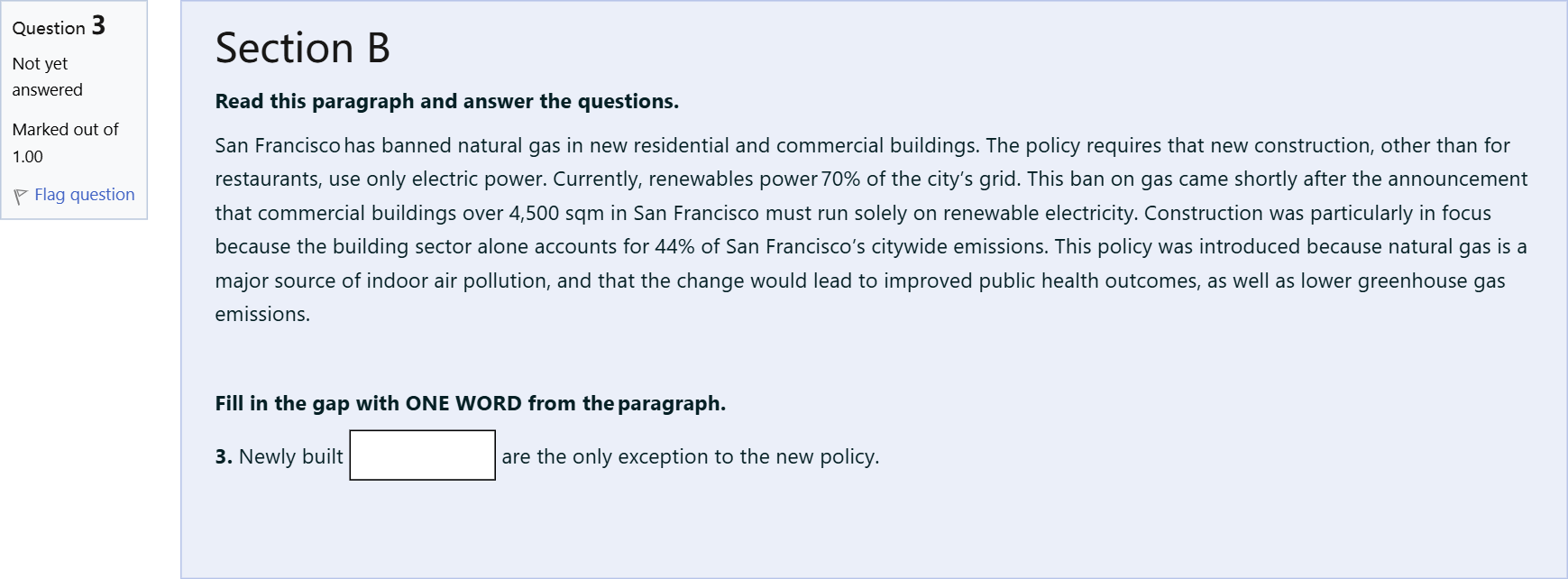
Section BRead this paragraph and answer the questions. San Francisco has banned natural gas in new residential and commercial buildings. The policy requires that new construction, other than for restaurants, use only electric power. Currently, renewables power 70% of the city’s grid. This ban on gas came shortly after the announcement that commercial buildings over 4,500 sqm in San Francisco must run solely on renewable electricity. Construction was particularly in focus because the building sector alone accounts for 44% of San Francisco’s citywide emissions. This policy was introduced because natural gas is a major source of indoor air pollution, and that the change would lead to improved public health outcomes, as well as lower greenhouse gas emissions. Fill in the gap with ONE WORD from the paragraph. 3. Newly built Answer Question 3[input] are the only exception to the new policy.

View Explanation
Verified Answer
Please login to view
Step-by-Step Analysis
First, restating the prompt in my own words helps anchor the context: San Francisco bans natural gas in new buildings, with the requirement that new construction, except for restaurants, uses only electric power. The question asks to fill the gap in the sentence: '3. Newly built _____ are the only exception to the new policy.......Login to view full explanationLog in for full answers
We've collected over 50,000 authentic exam questions and detailed explanations from around the globe. Log in now and get instant access to the answers!
Similar Questions
Section ARead this paragraph and answer the questions. With rapid urbanization, cities face growing challenges related to transportation. As populations swell, so does the demand for mobility, leading to increased traffic congestion, air pollution, and carbon emissions. To combat these issues, cities are turning towards sustainable transport solutions. This includes investing in public transportation infrastructure like buses, trams, and metro systems, which offer efficient and eco-friendly alternatives to private cars. Moreover, promoting walking and cycling infrastructure not only reduces reliance on motor vehicles but also promotes healthier lifestyles. Initiatives such as carpooling, ride-sharing, and electric vehicle adoption further contribute to creating more sustainable urban transport networks. By prioritizing sustainable transportation, cities can alleviate traffic congestion, improve air quality, and mitigate the environmental impact of urbanization, ultimately creating healthier and more livable urban environments for all residents. Fill in the gap with ONE WORD from the paragraph.1. As cities grow, the increasing Answer Question 1[input] from residents for transport options poses problems.
The circular economy model aims to protect the environment without lowering 25. ___. Improvements in 26. ____ can reduce waste and protect the environment. Introducing 27. ____ for recycling, reselling and sharing allows consumers to reuse the same clothes. The 28. Answer Question 28[input] of unprocessed resources, therefore, falls. The power of consumers and cooperation among decision-makers is crucial for encouraging ethical practices. This means that the fashion industry can be 29. ____ while remaining profitable.
The circular economy model aims to protect the environment without lowering 25. ____. Improvements in 26. ____ can reduce waste and protect the environment. Introducing 27. Answer Question 27[input] for recycling, reselling and sharing allows consumers to reuse the same clothes. The 28. ____ of unprocessed resources, therefore, falls. The power of consumers and cooperation among decision-makers is crucial for encouraging ethical practices. This means that the fashion industry can be 29. ____ while remaining profitable.
The circular economy model aims to protect the environment without lowering 25. ____. Improvements in 26. Answer Question 26[input] can reduce waste and protect the environment. Introducing 27. _____ for recycling, reselling and sharing allows consumers to reuse the same clothes. The 28. _____ of unprocessed resources, therefore, falls. The power of consumers and cooperation among decision-makers is crucial for encouraging ethical practices. This means that the fashion industry can be 29. _____ while remaining profitable.
More Practical Tools for Students Powered by AI Study Helper
Making Your Study Simpler
Join us and instantly unlock extensive past papers & exclusive solutions to get a head start on your studies!