
Questions
Multiple fill-in-the-blank
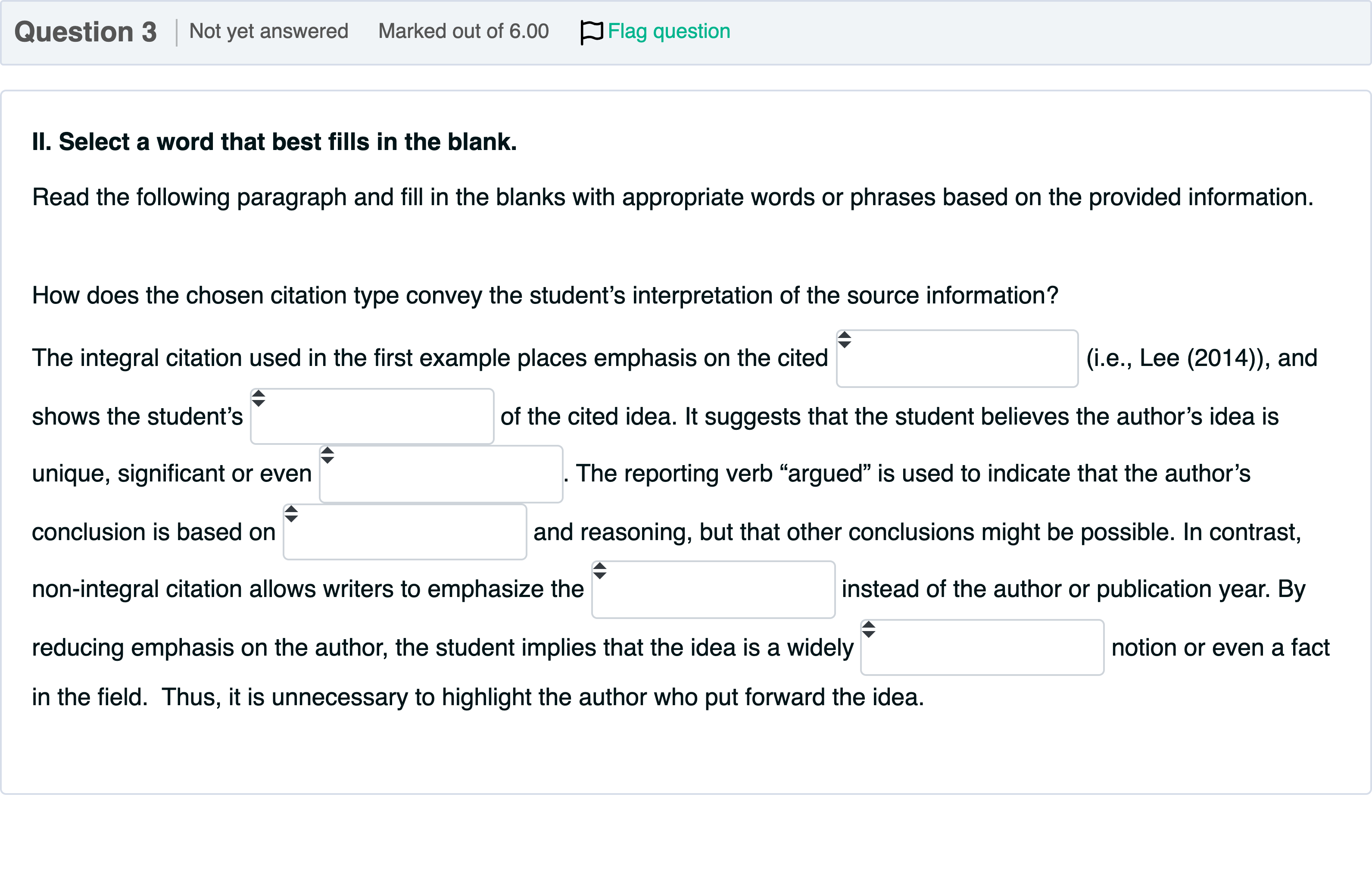
Question text <!-- function msoCommentShow(anchor_id, com_id) { if(msoBrowserCheck()) { c = document.all(com_id); a = document.all(anchor_id); if (null != c && null == c.length && null != a && null == a.length) { var cw = c.offsetWidth; var ch = c.offsetHeight; var aw = a.offsetWidth; var ah = a.offsetHeight; var x = a.offsetLeft; var y = a.offsetTop; var el = a; while (el.tagName != "BODY") { el = el.offsetParent; x = x + el.offsetLeft; y = y + el.offsetTop; } var bw = document.body.clientWidth; var bh = document.body.clientHeight; var bsl = document.body.scrollLeft; var bst = document.body.scrollTop; if (x + cw + ah / 2 > bw + bsl && x + aw - ah / 2 - cw >= bsl ) { c.style.left = x + aw - ah / 2 - cw; } else { c.style.left = x + ah / 2; } if (y + ch + ah / 2 > bh + bst && y + ah / 2 - ch >= bst ) { c.style.top = y + ah / 2 - ch; } else { c.style.top = y + ah / 2; } c.style.visibility = "visible"; } } } function msoCommentHide(com_id) { if(msoBrowserCheck()) { c = document.all(com_id); if (null != c && null == c.length) { c.style.visibility = "hidden"; c.style.left = -1000; c.style.top = -1000; } } } function msoBrowserCheck() { ms = navigator.appVersion.indexOf("MSIE"); vers = navigator.appVersion.substring(ms + 5, ms + 6); ie4 = (ms > 0) && (parseInt(vers) >= 4); return ie4; } if (msoBrowserCheck()) { document.styleSheets.dynCom.addRule(".msocomanchor","background: infobackground"); document.styleSheets.dynCom.addRule(".msocomoff","display: none"); document.styleSheets.dynCom.addRule(".msocomtxt","visibility: hidden"); document.styleSheets.dynCom.addRule(".msocomtxt","position: absolute"); document.styleSheets.dynCom.addRule(".msocomtxt","top: -1000"); document.styleSheets.dynCom.addRule(".msocomtxt","left: -1000"); document.styleSheets.dynCom.addRule(".msocomtxt","width: 33%"); document.styleSheets.dynCom.addRule(".msocomtxt","background: infobackground"); document.styleSheets.dynCom.addRule(".msocomtxt","color: infotext"); document.styleSheets.dynCom.addRule(".msocomtxt","border-top: 1pt solid threedlightshadow"); document.styleSheets.dynCom.addRule(".msocomtxt","border-right: 2pt solid threedshadow"); document.styleSheets.dynCom.addRule(".msocomtxt","border-bottom: 2pt solid threedshadow"); document.styleSheets.dynCom.addRule(".msocomtxt","border-left: 1pt solid threedlightshadow"); document.styleSheets.dynCom.addRule(".msocomtxt","padding: 3pt 3pt 3pt 3pt"); document.styleSheets.dynCom.addRule(".msocomtxt","z-index: 100"); } // --> II. Select a word that best fills in the blank. Read the following paragraph and fill in the blanks with appropriate words or phrases based on the provided information. How does the chosen citation type convey the student’s interpretation of the source information? The integral citation used in the first example places emphasis on the cited Answer 1 Question 3[select: , accepted, author, evidence, groundbreaking, information, interpretation] (i.e., Lee (2014)), and shows the student’s Answer 2 Question 3[select: , accepted, author, evidence, groundbreaking, information, interpretation] of the cited idea. It suggests that the student believes the author’s idea is unique, significant or even Answer 3 Question 3[select: , accepted, author, evidence, groundbreaking, information, interpretation]. The reporting verb “argued” is used to indicate that the author’s conclusion is based on Answer 4 Question 3[select: , accepted, author, evidence, groundbreaking, information, interpretation] and reasoning, but that other conclusions might be possible. In contrast, non-integral citation allows writers to emphasize the Answer 5 Question 3[select: , accepted, author, evidence, groundbreaking, information, interpretation] instead of the author or publication year. By reducing emphasis on the author, the student implies that the idea is a widely Answer 6 Question 3[select: , accepted, author, evidence, groundbreaking, information, interpretation] notion or even a fact in the field. Thus, it is unnecessary to highlight the author who put forward the idea.

View Explanation
Verified Answer
Please login to view
Step-by-Step Analysis
The prompt asks you to fill in six blanks with the provided words, forming a coherent analysis of citation types. I will examine each blank in order and explain why the chosen word fits, while also showing why the other options would be inappropriate.
Blank 1: The integral citation used in the first example places emphasis on the cited ______ (i.e., Lee (2014))...
- Correct choice: author
- Why: An integral (or full) citation typically foregrounds the author and source, highlighting who authored the idea and when it appeared. The phrase immediately after is “(i.e., Lee (2014)),” which directly points to the author and publication year, confirming that the intended word is the author.
- Why not other options: interpretation would shift the focus from who wrote it to what the idea means; groundbreaking would describe the significance, not......Login to view full explanationLog in for full answers
We've collected over 50,000 authentic exam questions and detailed explanations from around the globe. Log in now and get instant access to the answers!
Similar Questions
When using information in a research project, what is the most ethical way to handle the sources you’ve consulted?
Question at position 4 How should you acknowledge other people's ideas, images, or data in your presentation?By ignoring themBy using them without any citationThrough spoken words and/or references on visual aids By listing them in the introduction
To avoid committing plagiarism, select the type of sources that you would cite when submitting a final project:
Why is it important to do citations?
More Practical Tools for Students Powered by AI Study Helper
Making Your Study Simpler
Join us and instantly unlock extensive past papers & exclusive solutions to get a head start on your studies!