
Questions
SPHY001 Graded Quiz 3 (Unit 5 and Unit 6)- Requires Respondus LockDown Browser
Single choice
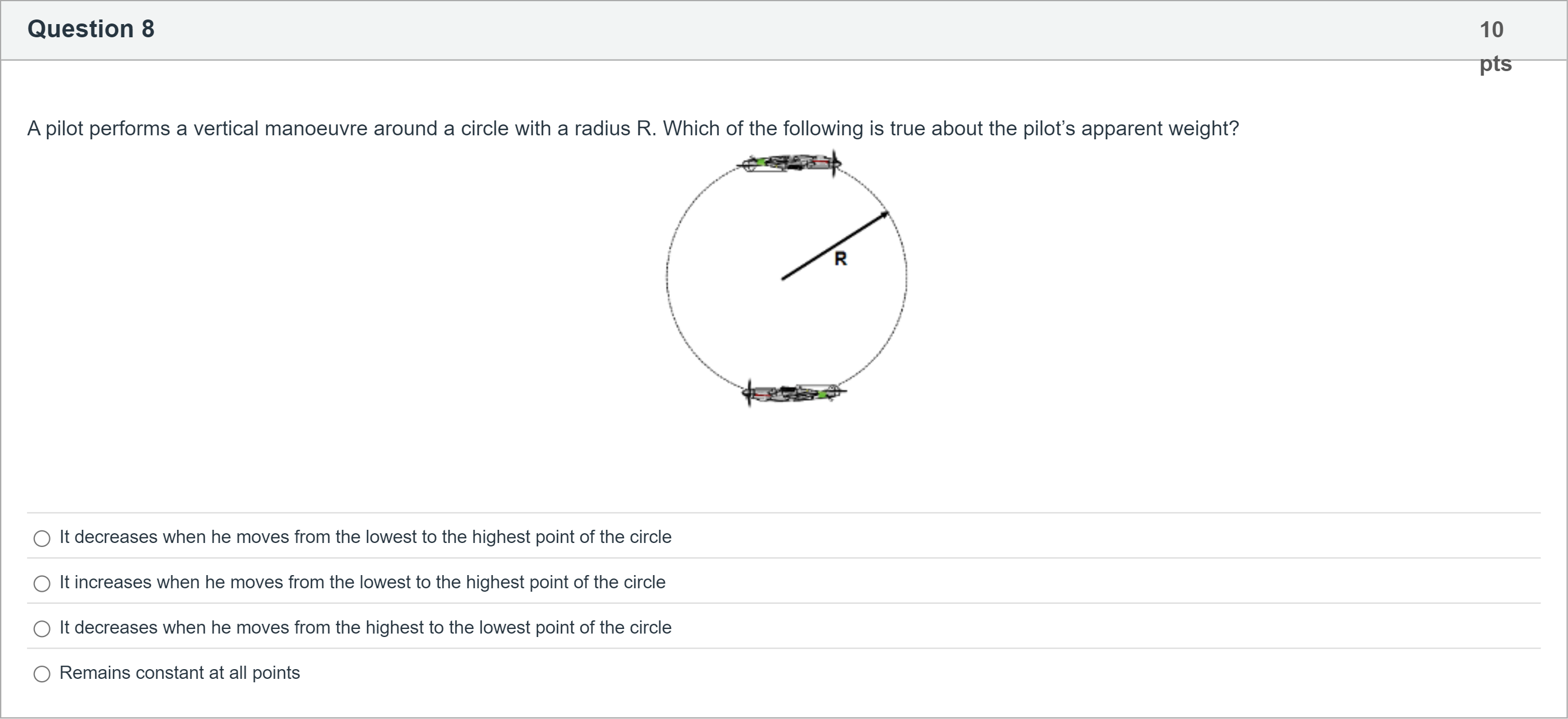
A pilot performs a vertical manoeuvre around a circle with a radius R. Which of the following is true about the pilot’s apparent weight?
Options
A.It decreases when he moves from the lowest to the highest point of the circle
B.It increases when he moves from the lowest to the highest point of the circle
C.It decreases when he moves from the highest to the lowest point of the circle
D.Remains constant at all points

View Explanation
Verified Answer
Please login to view
Step-by-Step Analysis
Consider the vertical circular motion and what the pilot feels as apparent weight, which is the normal force exerted by the seat on the pilot.
Option 1: It decreases when he moves from the lowest to the highest point of the circle. At the bottom, the centripetal force requirement m v^2 / R is provided b......Login to view full explanationLog in for full answers
We've collected over 50,000 authentic exam questions and detailed explanations from around the globe. Log in now and get instant access to the answers!
Similar Questions
A coin is placed on a rotating disc whose angular velocity is 1 rev/s. If the coefficient of static friction between the coin and the disc is 0.6 what is the maximum distance from the center of the disc that the coin can be placed without it slipping off?
A coin is placed on a disk that is rotating at 2rev/s. If the coefficient of static friction between the coin and the disc is 0.6 what is the maximum distance from the center of the disc that the coin can be placed without it slipping off?
The diagram below shows a 3.8 kg object being spun around in a circle from a 1.0 m long massless string.The angle [math: θ] \theta is 26.8 degrees.Determine the magnitude of the tension (N) in the string.Give your answer correct to 2 decimal places without units.
An object is in uniform circular motion. Identify the correct statement(s). (1) Its acceleration is constant. (2) Its radial acceleration component is constant in magnitude. (3) Its tangential acceleration component is non-zero and constant in magnitude.
More Practical Tools for Students Powered by AI Study Helper
Making Your Study Simpler
Join us and instantly unlock extensive past papers & exclusive solutions to get a head start on your studies!