
Questions
CHM1051 MUM S2 2025 CHM1051 Practice Exam 2
Single choice
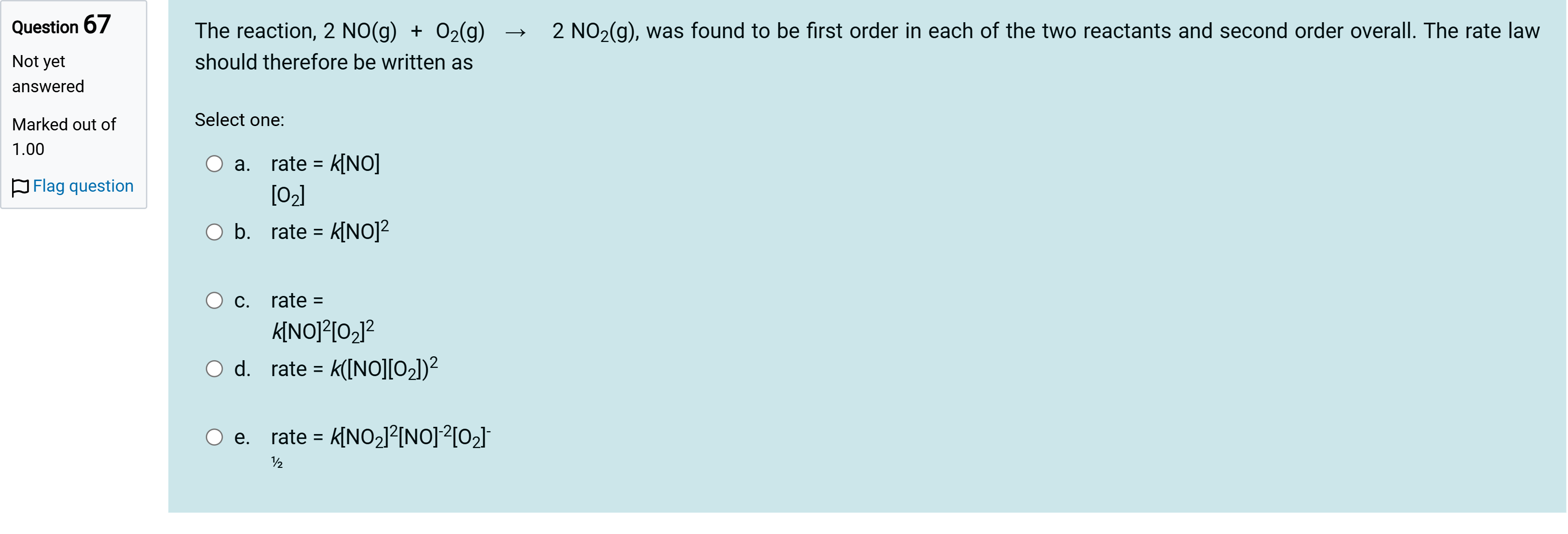
The reaction, 2 NO(g) + O2(g) → 2 NO2(g), was found to be first order in each of the two reactants and second order overall. The rate law should therefore be written as
Options
A.a. rate = k[NO][O2]
B.b. rate = k[NO]2
C.c. rate = k[NO]2[O2]2
D.d. rate = k([NO][O2])2
E.e. rate = k[NO2]2[NO]-2[O2]-½

View Explanation
Verified Answer
Please login to view
Step-by-Step Analysis
To begin analyzing the rate law, we note the overall reaction order and the given information. The reaction 2 NO(g) + O2(g) → 2 NO2(g) is described as first order in each reactant and second order overall. This directly means the rate law must have first-order dependence on both NO and O2, and the exponents must s......Login to view full explanationLog in for full answers
We've collected over 50,000 authentic exam questions and detailed explanations from around the globe. Log in now and get instant access to the answers!
Similar Questions
Given a reaction, A → B + C, for which the observed rate law is rate = k[A]0, which one of the following is true?
Nitrogen dioxide decomposes via the following reaction, NO2(g) → NO(g) + 1/2O2(g) The experimental rate law is rate = k[NO2]2. At a specific temperature the rate of reaction was found to be 7.50 x 10⁻⁴ mol L-1 s-1. Which unit below is the correct unit for the rate constant in this case?
Which of the following statements is FALSE?
Which of the following statements is/are correct for the first-order reaction: A → P? I. The concentration of A decreases linearly with time. II. The rate of reaction is constant. III. A plot of ln[A] versus time is a straight line with the slope equal to -k.
More Practical Tools for International Students
Making Your Study Simpler
Join us and instantly unlock extensive past papers & exclusive solutions to get a head start on your studies!