
Questions
BIOL 1001 (001-013) Exam 4: Unit 4
Multiple dropdown selections
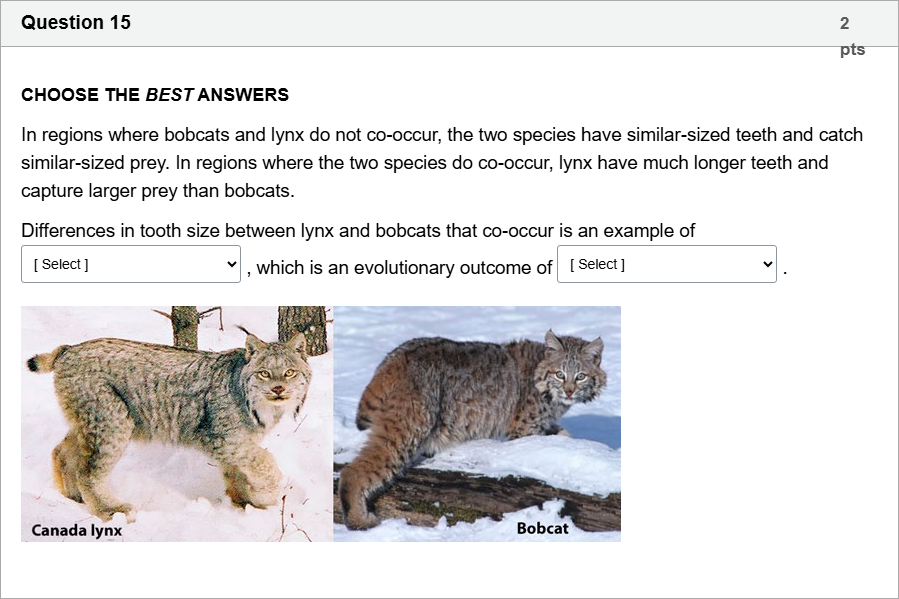
CHOOSE THE BEST ANSWERS In regions where bobcats and lynx do not co-occur, the two species have similar-sized teeth and catch similar-sized prey. In regions where the two species do co-occur, lynx have much longer teeth and capture larger prey than bobcats. Differences in tooth size between lynx and bobcats that co-occur is an example of [ Select ] Competitive exclusion Competitive interference Competitive exploitation Character displacement , which is an evolutionary outcome of [ Select ] predation competition commensalism mutualism .

View Explanation
Verified Answer
Please login to view
Step-by-Step Analysis
This question presents two related prompts about how species differences evolve in the presence of another similar species.
First, consider the statement: Differences in tooth size between lynx and bobcats that co-occur is an example of ________ , which is an evolutionary outcome of ________ .
Option 1: Competitive exclusion. This idea states that two species competing for the same resources cannot stably coexist, leading to one species being excluded. It does not directly describe how trait differences arise between co-occurring spec......Login to view full explanationLog in for full answers
We've collected over 50,000 authentic exam questions and detailed explanations from around the globe. Log in now and get instant access to the answers!
Similar Questions
Where species with overlapping niches compete, then can diversify through the process of ________ _________, resulting in niche diversification and co-existence (answer is two words)
Larger crayfish are better at defending shelters than smaller crayfish, regardless of what species they are. Small crayfish can escape competition by occupying small rocks that are not sought after by larger crayfish. The size distribution of the two species is shown in the frequency versus size graph. What is the most likely outcome of competition between species A and B? Competitive coexistence The two species have evolved different body sizes. This is an example character displacement , an evolutionary outcome of competition.
Geospiza fortis is a seed-eating finch that lives on Daphne Major, a small island in the Galápagos archipelago. Geospiza fuliginosa is a second species of seed-eating finch found in the Galápagos islands, and this species occurs together with G. fortis on a larger island called Santa Cruz. The graphs below show the distribution of beak sizes of G. fortis when it co-occurs with G. fuliginosa vs. when it occurs alone. Based only on these data, you can conclude that (select all that apply).
On the Galapagos Islands, two species of finches display a character displacement when they occur as sympatric species. Which of the statements correctly interprets the species over time when they are found sympatrically?
More Practical Tools for Students Powered by AI Study Helper
Making Your Study Simpler
Join us and instantly unlock extensive past papers & exclusive solutions to get a head start on your studies!