
Questions
MATH*2415*W16 Quiz 2 (Nov 4)- Requires Respondus LockDown Browser
Single choice
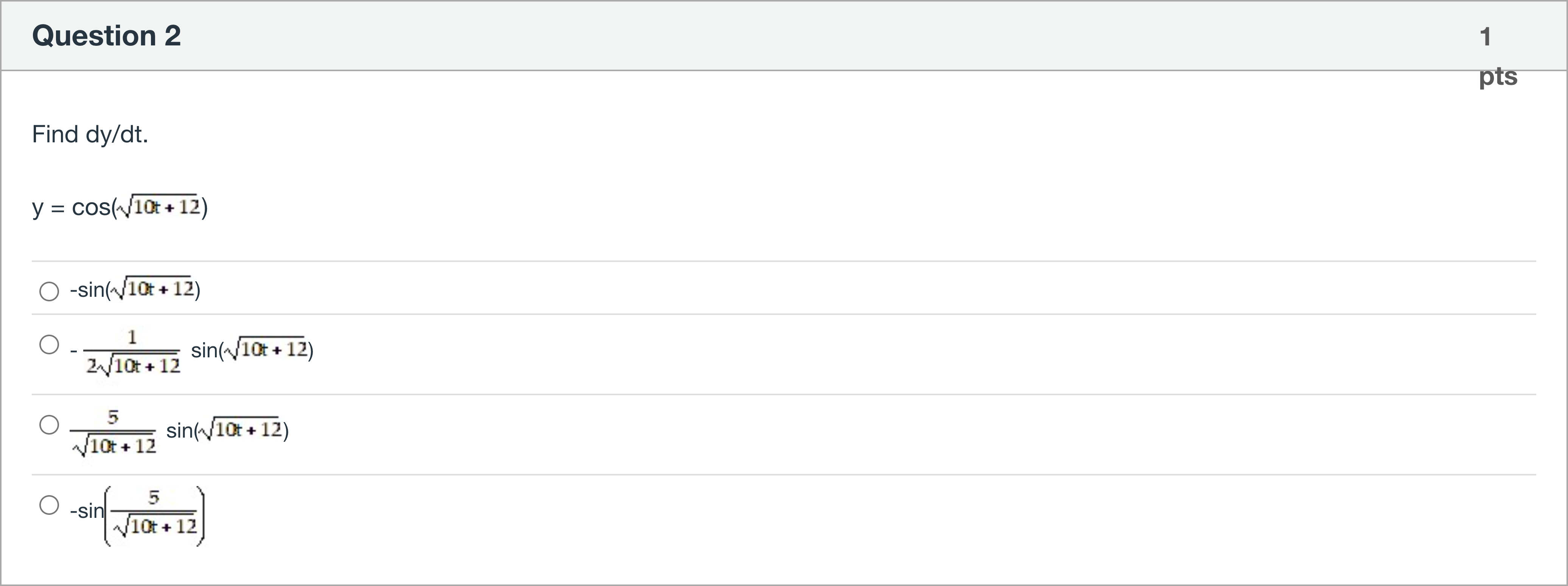
Find dy/dt. y = cos()
Options
A.-sin()
B.- sin()
C.sin()
D.-sin

View Explanation
Verified Answer
Please login to view
Step-by-Step Analysis
To find dy/dt for y = cos(√(10t+12)), we must apply the chain rule twice. First, differentiate the outer cosine with respect to its inner argument: d/dx [cos(x)] = -sin(x). Next, differentiate the inner function x = √(10t+12) with respect to t: d/dt [√(10t+12)] = (10)/(2√(10t+12)) = 5......Login to view full explanationLog in for full answers
We've collected over 50,000 authentic exam questions and detailed explanations from around the globe. Log in now and get instant access to the answers!
Similar Questions
Differentiate 5 sin ( 𝑥 3 + 2 𝑥 )
Which rule would be used to differentiate the function
If wanting to differentiate: 𝑦 = 1 𝑥 2 + 1 The most appropriate rule to use would be the [ Select ] chain general right handed product rule
<math xmlns="http://www.w3.org/1998/Math/MathML"><mtext>The differentiable functions </mtext><mi>f</mi><mtext> and </mtext><mi>g</mi><mtext> are defined for all real numbers </mtext><mi>x</mi><mo>.</mo><mtext> Values of </mtext><mi>f</mi><mo>,</mo><msup><mi>f</mi><mo>′</mo></msup><mo>,</mo><mi>g</mi><mo>,</mo><mtext> and </mtext><msup><mi>g</mi><mo>′</mo></msup><mtext> for various values of </mtext><mi>x</mi><mtext> are given in the table.</mtext></math>\text{The differentiable functions } f \text{ and } g \text{ are defined for all real numbers } x. \text{ Values of } f, f', g, \text{ and } g' \text{ for various values of } x \text{ are given in the table.} <math xmlns="http://www.w3.org/1998/Math/MathML"><mtext>Suppose that</mtext><mtext> </mtext><mi>h</mi><mo stretchy="false">(</mo><mi>x</mi><mo stretchy="false">)</mo><mo>=</mo><mi>f</mi><mo stretchy="false">(</mo><mi>g</mi><mo stretchy="false">(</mo><mi>x</mi><mo stretchy="false">)</mo><mo stretchy="false">)</mo><mtext> </mtext><mtext>and</mtext><mtext> </mtext><mi>H</mi><mo stretchy="false">(</mo><mi>x</mi><mo stretchy="false">)</mo><mo>=</mo><mi>f</mi><mo stretchy="false">(</mo><mi>g</mi><mo stretchy="false">(</mo><mi>x</mi><mo stretchy="false">)</mo><mo stretchy="false">)</mo><mo>.</mo><mtext> </mtext><mtext>Determine the following quantities.</mtext></math>\text{Suppose that} \ h(x)=f(g(x)) \ \text{and} \ H(x)=f(g(x)). \ \text{Determine the following quantities.} (a) <math xmlns="http://www.w3.org/1998/Math/MathML"><msup><mi>h</mi><mo>′</mo></msup><mo stretchy="false">(</mo><mn>1</mn><mo stretchy="false">)</mo><mo>=</mo></math>h'(1)=[Fill in the blank], (b) <math xmlns="http://www.w3.org/1998/Math/MathML"><msup><mi>H</mi><mo>′</mo></msup><mo stretchy="false">(</mo><mn>1</mn><mo stretchy="false">)</mo><mo>=</mo></math>H'(1)=[Fill in the blank],
More Practical Tools for Students Powered by AI Study Helper
Making Your Study Simpler
Join us and instantly unlock extensive past papers & exclusive solutions to get a head start on your studies!