Still overwhelmed by exam stress? You've come to the right place!
We know exam season has you totally swamped. To support your studies, access Gold Membership for FREE until December 31, 2025! Normally £29.99/month. Just Log In to activate – no strings attached.
Let us help you ace your exams efficiently!

Questions
Single choice
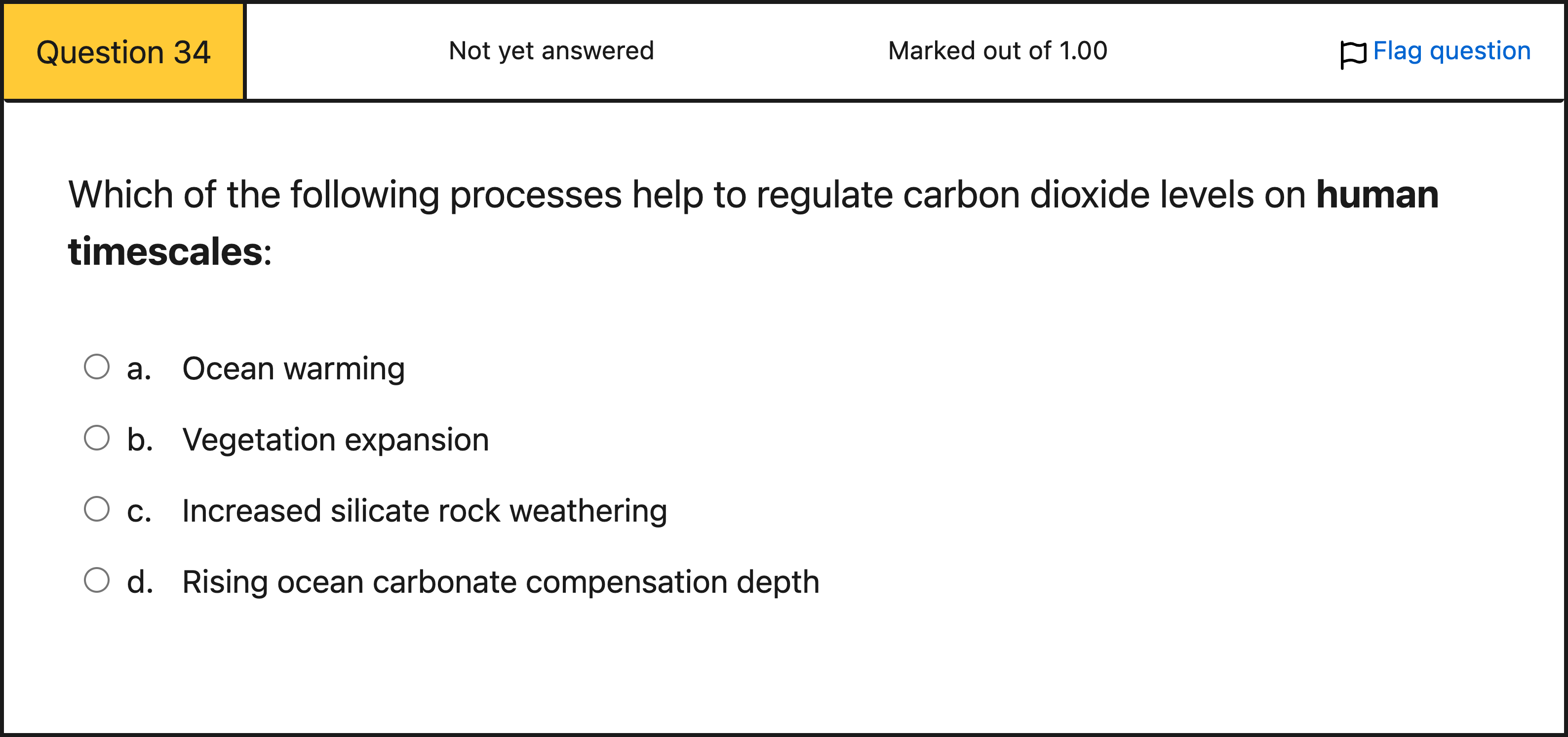
Which of the following processes help to regulate carbon dioxide levels on human timescales:
Options
A.a. Ocean warming
B.b. Vegetation expansion
C.c. Increased silicate rock weathering
D.d. Rising ocean carbonate compensation depth

View Explanation
Standard Answer
Please login to view
Approach Analysis
The question asks which processes help regulate carbon dioxide levels on human timescales, so we need to evaluate each option in terms of how quickly and effectively it can affect atmospheric CO2.
Option a: Ocean warming. While ocean warming is related to climate change and can influence carbon cycling, higher temperatures typically reduce the solubility of CO2 in seawater and can decrease the ocean’s capacity to absorb CO2 i......Login to view full explanationLog in for full answers
We've collected over 50,000 authentic exam questions and detailed explanations from around the globe. Log in now and get instant access to the answers!
Similar Questions
Which of the following processes help to regulate carbon dioxide levels on human timescales:
Which of the following processes help to regulate carbon dioxide levels on human timescales:
If Earth’s oceans are carbon dioxide sinks, that means that carbon dioxide should remain in oceans infinitely. Is that accurate?
Fossil fuels contribute to global warming through the carbon cycle in part because fossil fuels are extracted from the ground, and then burned. This adds carbon that was in the ground to the atmosphere.
More Practical Tools for International Students
Making Your Study Simpler
To make preparation and study season easier for more international students, we've decided to open up Gold Membership for a limited-time free trial until December 31, 2025!