
Questions
MUF0042 Chemistry Unit 2 - Semester 2, 2025
Multiple fill-in-the-blank
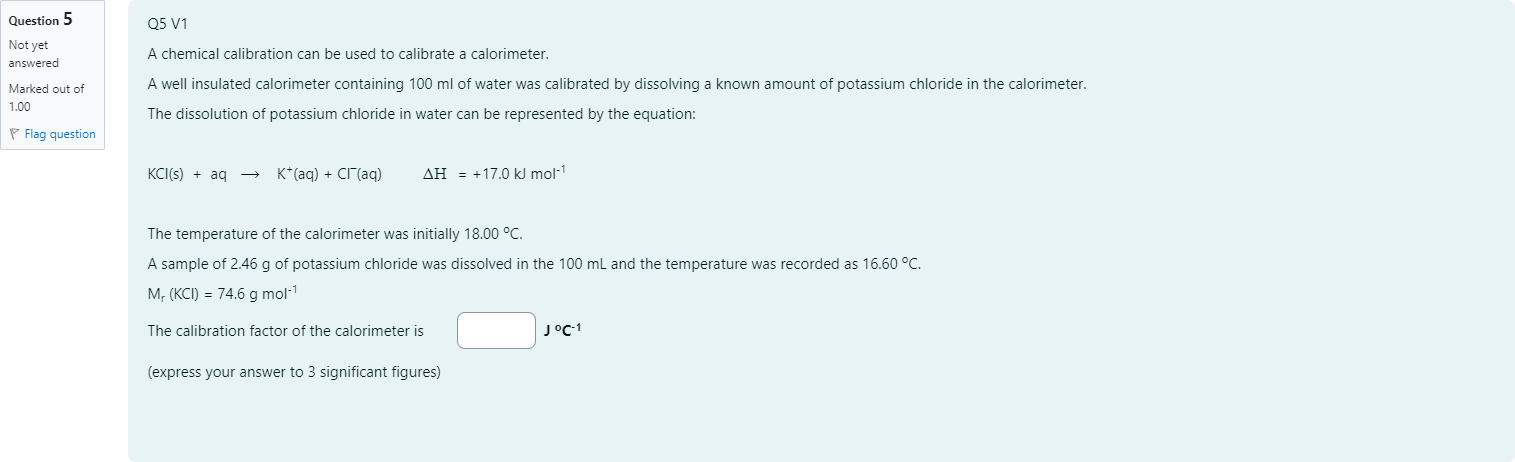
Question textQ5 V1A chemical calibration can be used to calibrate a calorimeter.A well insulated calorimeter containing 100 ml of water was calibrated by dissolving a known amount of potassium chloride in the calorimeter.The dissolution of potassium chloride in water can be represented by the equation:KCl(s) + aq [math: ⟶]\ce{ -> } K+(aq) + Cl‾(aq) [math: ΔH]\ce{ $\Delta H$ } = +17.0 kJ mol-1The temperature of the calorimeter was initially 18.00 oC.A sample of 2.46 g of potassium chloride was dissolved in the 100 mL and the temperature was recorded as 16.60 oC.Mr (KCl) = 74.6 g mol-1The calibration factor of the calorimeter is Answer 1 Question 5[input] J oC-1(express your answer to 3 significant figures)

View Explanation
Verified Answer
Please login to view
Step-by-Step Analysis
Let's work through the problem step by step to understand how the calibration factor is obtained.
First, restate the key data: a well-insulated calorimeter contains 100 mL of water (approximately 100 g). Potassium chloride (KCl) dissolves with ΔH = +17.0 kJ/mol (endothermic). A sample of 2.46 g KCl is dissolved. The calorimeter temperature drops from 18.00 °C to 16.60 °C, a ΔT of -1.40 °C. The molar mass of KCl is 74.6 g/mol.
Next, determine the amount of KCl in moles: n(KCl) = mass / M = 2.46 g / 74.6 g/mol ≈ 0.0330 mol (to three significant figures).
Now compute the heat change associat......Login to view full explanationLog in for full answers
We've collected over 50,000 authentic exam questions and detailed explanations from around the globe. Log in now and get instant access to the answers!
Similar Questions
Consider the combustion of a 0.30 g sample of butter in a bomb calorimeter having a heat capacity of 2.67 kJ/°C. If the temperature of the calorimeter increases from 23.5°C to 27.3°C, what is the energy of combustion (in kJ/g) of butter. 06A
When a 5.90 g sample of a solid (MM = 115 g/mol) dissolves in 120.0 g of water in a coffee-cup calorimeter, the temperature falls from 21.60°C to 17.20°C. Assuming the specific heat of the solution is the same as pure water (4.18 J/g-K), answer the following questions: I: Is the dissolution of the solid endothermic or exothermic? [ Select ] endothermic exothermic II: What is ΔH (in kJ/mol) for the dissolution of the solid? [ Select ] 43.0 kJ/mol 45.1 kJ/mol 2.21 kJ/mol 2.32 kJ/mol 05A
Question textQ4 V32.568 g of yellow sulfur (S8) is burned in a bomb calorimeter with excess oxygen. The temperature of the calorimeter and its contents increases for this burning from 21.00 oC to 31.00 oC.The calibration factor of the calorimeter was previously found to be 725 J K-1What is the enthalpy change (ΔH) for the following the reaction? (Mr(S) = 32.1 g mol-1, Mr(O) = 16.0 g mol-1)S8(s) + 8O2(g) [math: ⟶]\ce{ -> } 8SO2(g) Answer 1 Question 4[input] kJ mol-1.
Q3 V3If the temperature of 100 mL of solution increased by 3 Kelvin (K) during the reaction and the specific heat capacity of the solution is 4.18 J/g°C, how much heat energy was absorbed?
More Practical Tools for Students Powered by AI Study Helper
Making Your Study Simpler
Join us and instantly unlock extensive past papers & exclusive solutions to get a head start on your studies!