
Questions
Multiple fill-in-the-blank
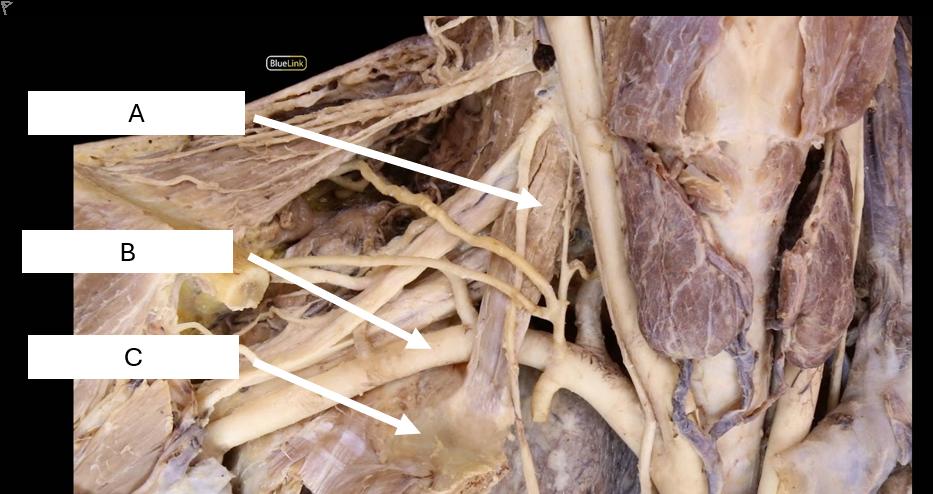
Question textIdentify A: Answer 1 Question 4[input]Name and action of A: Answer 2 Question 4[input]Identify B: Answer 3 Question 4[input]Identify C: Answer 4 Question 4[input]

View Explanation
Verified Answer
Please login to view
Step-by-Step Analysis
Analyzing the fill-in-the-blank prompts requires matching each labeled structure to its nerve and, for the second blank, its function.
A) Identify A: Musculocutaneous nerve. This nerve courses with the upper limb flexors and is typically associated with the anterior compartment of the arm, supplying flexors such as the biceps brachii. In t......Login to view full explanationLog in for full answers
We've collected over 50,000 authentic exam questions and detailed explanations from around the globe. Log in now and get instant access to the answers!
Similar Questions
The lateral cord gives rise to which terminal branches of the brachial plexus?
Damage to the medial cord of the brachial plexus would likely weaken which of the following areas?
What part of the brachial plexus does the long thoracic nerve originate from?
Match the nerve to its correct description. Some answer options may not be used. 1: Nerve that contains axons from only levels C5 and C6. 2: Nerve that travels with the deep brachial artery, and innervates posterior arm and forearm. 3: Nerve that innervates the latissimus dorsi muscle. 4: Nerve that travels posterior to the elbow joint; it is the nerve affected when you hit your "funny bone". 5: Nerve compressed in carpal tunnel syndrome. 6: Nerve that innervates the muscles of anterior compartment of the arm. 7: Innervates the serratus anterior muscle
More Practical Tools for Students Powered by AI Study Helper
Making Your Study Simpler
Join us and instantly unlock extensive past papers & exclusive solutions to get a head start on your studies!