
Questions
APBIO142-030 with labs Unit 6 Test
Single choice
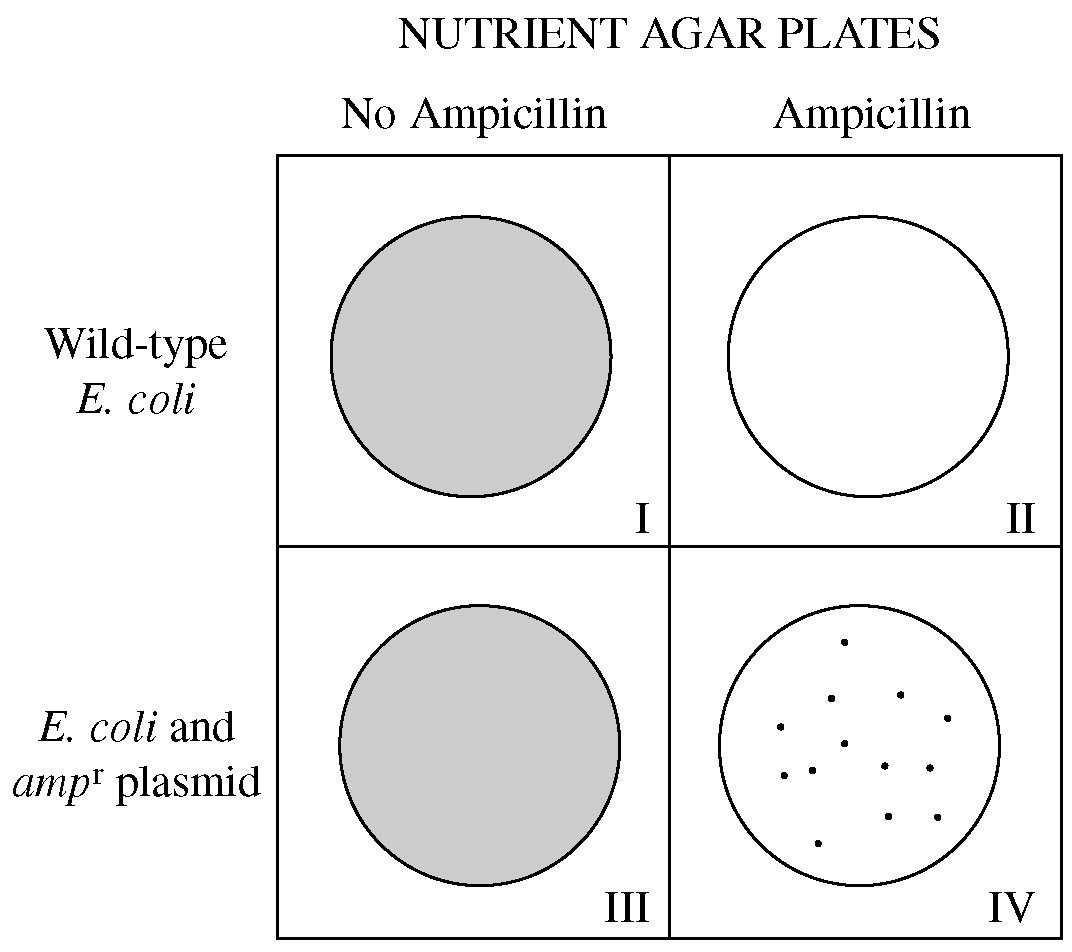
In a transformation experiment, a sample of E. coli bacteria was mixed with a plasmid containing the gene for resistance to the antibiotic ampicillin (ampr). Plasmid was not added to a second sample. Samples were plated on nutrient agar plates, some of which were supplemented with the antibiotic ampicillin. The results of E. coli growth are summarized below. The shaded area represents extensive growth of bacteria; dots represent individual colonies of bacteria. Plates that have only ampicillin-resistant bacteria growing include which of the following?
Options
A.I only
B.I and II
C.III only
D.IV only

View Explanation
Verified Answer
Please login to view
Step-by-Step Analysis
To tackle this question, we must compare growth patterns across plates with and without ampicillin, and relate them to the presence or absence of the ampicillin resistance gene (ampr) on the plasmid.
Option I only: This choice would assert that only plate I shows growth of ampicillin-resistant bacteria. However, plate I is the wild-type E. coli with no plasmid, which should not acquire ampicillin resistance and thus should not grow on ampicillin-containing plates. Since plate II (ampicillin without plasmid) shows no growth, plate I alone does no......Login to view full explanationLog in for full answers
We've collected over 50,000 authentic exam questions and detailed explanations from around the globe. Log in now and get instant access to the answers!
Similar Questions
Bacterial transformation is a highly efficient process
If an experiment is set up to show transformation in bacteria, what must be present in the environment for it to be successful?
Bacterial transformation occurs when
Frederic Griffiths experiments involved two different strains of a bacteria that causes pneumonia in mammals: a disease causing strain, called the smooth strain, and a harmless strain, called the rough strain. As expected, when healthy mice were injected with the smooth strain they died, and when there were injected with the rough strain they lived. When the smooth strain bacteria were killed with heat and injected into healthy mice, the mice were fine. However, when heat-killed smooth strain bacteria and rough strain bacteria were injected together into healthy mice, the mice died. The healthy mice injected with heat-killed smooth strain bacteria were
More Practical Tools for Students Powered by AI Study Helper
Making Your Study Simpler
Join us and instantly unlock extensive past papers & exclusive solutions to get a head start on your studies!