
Questions
2025-PSB-MIC1IPE(SP-T3-FT) - INFECTIONS, PANDEMICS AND EPIDEMICS
Single choice
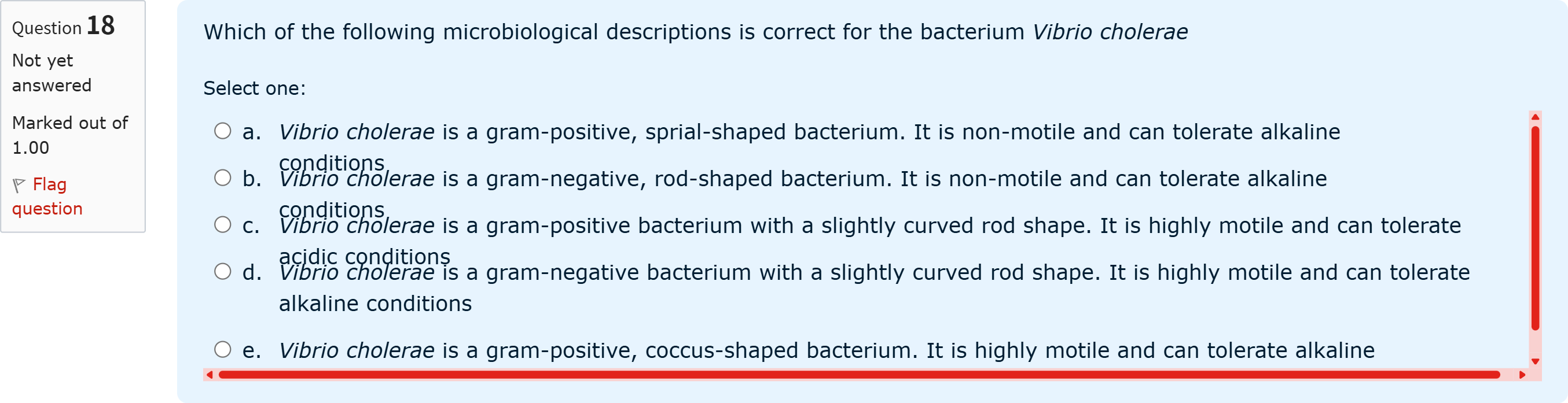
Which of the following microbiological descriptions is correct for the bacterium Vibrio cholerae
Options
A.a. Vibrio cholerae is a gram-positive, sprial-shaped bacterium. It is non-motile and can tolerate alkaline conditions
B.b. Vibrio cholerae is a gram-negative, rod-shaped bacterium. It is non-motile and can tolerate alkaline conditions
C.c. Vibrio cholerae is a gram-positive bacterium with a slightly curved rod shape. It is highly motile and can tolerate acidic conditions
D.d. Vibrio cholerae is a gram-negative bacterium with a slightly curved rod shape. It is highly motile and can tolerate alkaline conditions
E.e. Vibrio cholerae is a gram-positive, coccus-shaped bacterium. It is highly motile and can tolerate alkaline conditions

View Explanation
Verified Answer
Please login to view
Step-by-Step Analysis
Here is the question and each answer option analyzed in detail, with attention to what is correct and what is incorrect.
Option a: 'Vibrio cholerae is a gram-positive, spiral-shaped bacterium. It is non-motile and can tolerate alkaline conditions.' This option is inaccurate on multiple counts. Vibrio cholerae is not gram-positive; it is gram-negative. It is not spirally shaped but curved rod-shaped. Additionally, it is known to be motile, not non-motile, due to its polar flagella. The combination of gram-positive, spiral shape,......Login to view full explanationLog in for full answers
We've collected over 50,000 authentic exam questions and detailed explanations from around the globe. Log in now and get instant access to the answers!
Similar Questions
In this mixed culture, which pairing of A and B is MOST consistent with both morphology and Gram reaction?
In the Gram stain image, the mixed culture contains Bacillus sp. and Staphylococcus sp. Based on morphology, which interpretation of A and B is most correct?
Which of the following is NOT a type of bacteria?
Match the terms below with the correct morphology.... 1: Streptococci 2: Staphylococci 3: Streptobacilli 4: Diplobacilli
More Practical Tools for Students Powered by AI Study Helper
Making Your Study Simpler
Join us and instantly unlock extensive past papers & exclusive solutions to get a head start on your studies!