
Questions
Dashboard Final Exam
Single choice
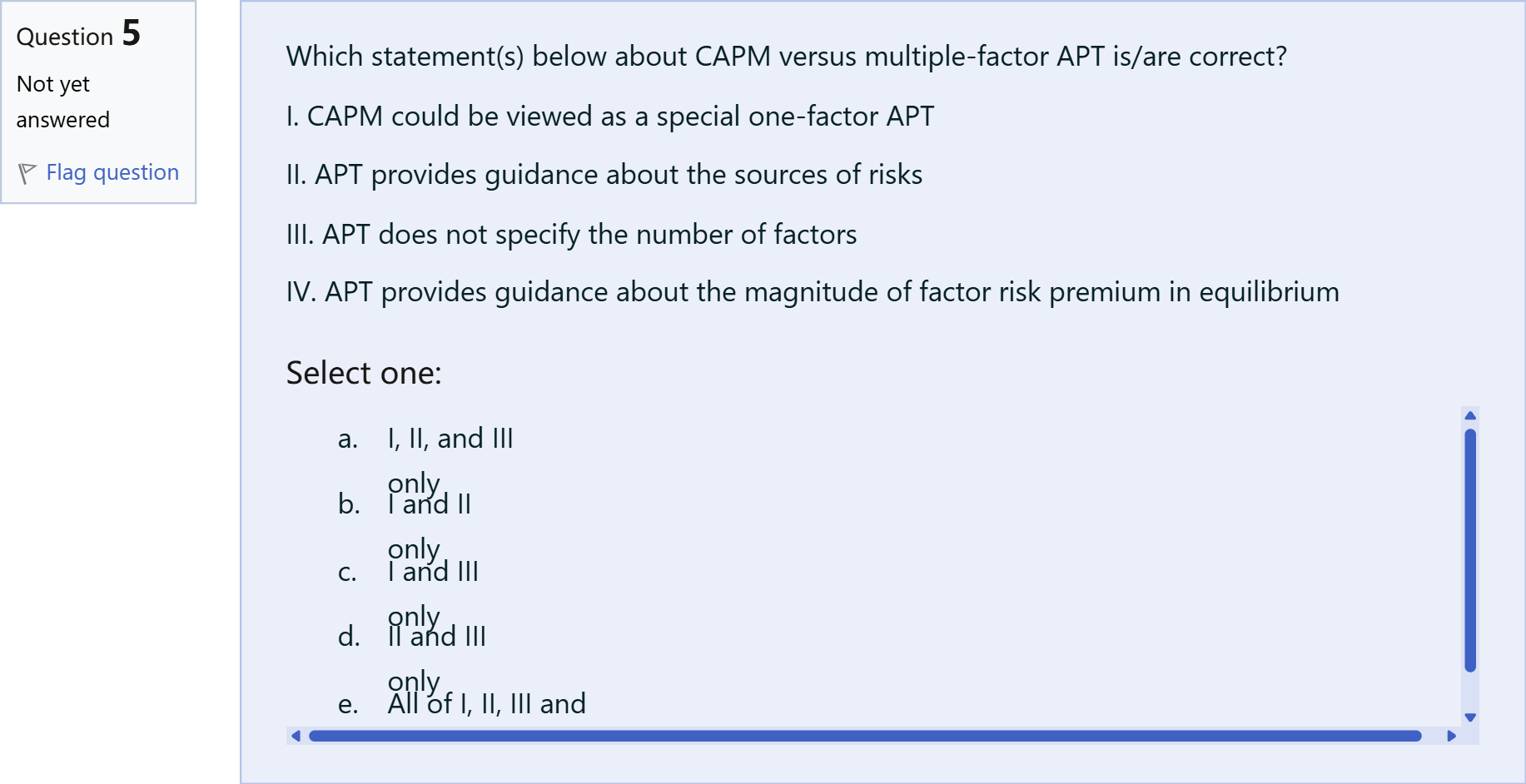
Which statement(s) below about CAPM versus multiple-factor APT is/are correct? I. CAPM could be viewed as a special one-factor APT II. APT provides guidance about the sources of risks III. APT does not specify the number of factors IV. APT provides guidance about the magnitude of factor risk premium in equilibrium
Options
A.a. I, II, and III only
B.b. I and II only
C.c. I and III only
D.d. II and III only
E.e. All of I, II, III and IV

View Explanation
Verified Answer
Please login to view
Step-by-Step Analysis
Question restatement: Which statement(s) below about CAPM versus multiple-factor APT is/are correct? I. CAPM could be viewed as a special one-factor APT II. APT provides guidance about the sources of risks III. APT does not specify the number of factors IV. APT provides guidance about the magnitude of factor risk premium in equilibrium
Option-by-option analysis:
- I. CAPM could be viewed as a special one-factor APT
This is a commonly accepted view in asset pricing. The CAPM can be derived as a one-factor......Login to view full explanationLog in for full answers
We've collected over 50,000 authentic exam questions and detailed explanations from around the globe. Log in now and get instant access to the answers!
Similar Questions
For a 5-factor asset pricing model, the following table represents the factor returns and the factor loadings (betas) for a company. Calculate the expected excess return (assume all returns are excess, includes the Risk-Free rate) for the company (answer in percent so 6.1% is 6.1). Factor 1 Factor 2 Factor 3 Factor 4 Factor 5 Factor Return in % 3.9 3.5 0.3 0 4.7 Factor Beta or Loading -1.6 -1.3 -0.3 -1.2 0
For a five factor asset pricing model, the following table represents the factor returns and the factor loadings (betas) for a company. Calculate the expected return for the company (answer in percent so 6.1% is 6.1). Factor 1 Factor 2 Factor 3 Factor 4 Factor 5 Factor Return in % 0.8 -1.4 -2.5 4.8 -2.9 Factor Beta or Loading -1.9 -1.3 -0.6 0 1.3
Using the Fama-French model, a firm has a Beta of HML of -0.5, Beta of SMB of -1.4, and Beta on the Market of 1.2. If the expected market risk premium is 7%, the HML return -2.2%, the risk-free rate is 3.3%, and SMB return 1.6%, what is the expected return of the firm? (Answer in % so 6.1% is 6.1 and to one decimal place).
Tom Ace, an equity analyst, uses the capital asset pricing model (CAPM) to help identify mispriced securities. A consultant advises Tom Ace to use arbitrage pricing theory (APT) instead. In comparing CAPM and APT, the consultant makes the following arguments: I. APT places more emphasis on market risk. II. Neither the CAPM nor the APT assumes investors are mean-variance optimizers. III. APT specifies the number and identifies specific factors that determine expected returns. IV. APT does not require restrictive assumptions concerning the market portfolio. Criticize the four arguments made by the consultant.
More Practical Tools for Students Powered by AI Study Helper
Making Your Study Simpler
Join us and instantly unlock extensive past papers & exclusive solutions to get a head start on your studies!