
Questions
Single choice
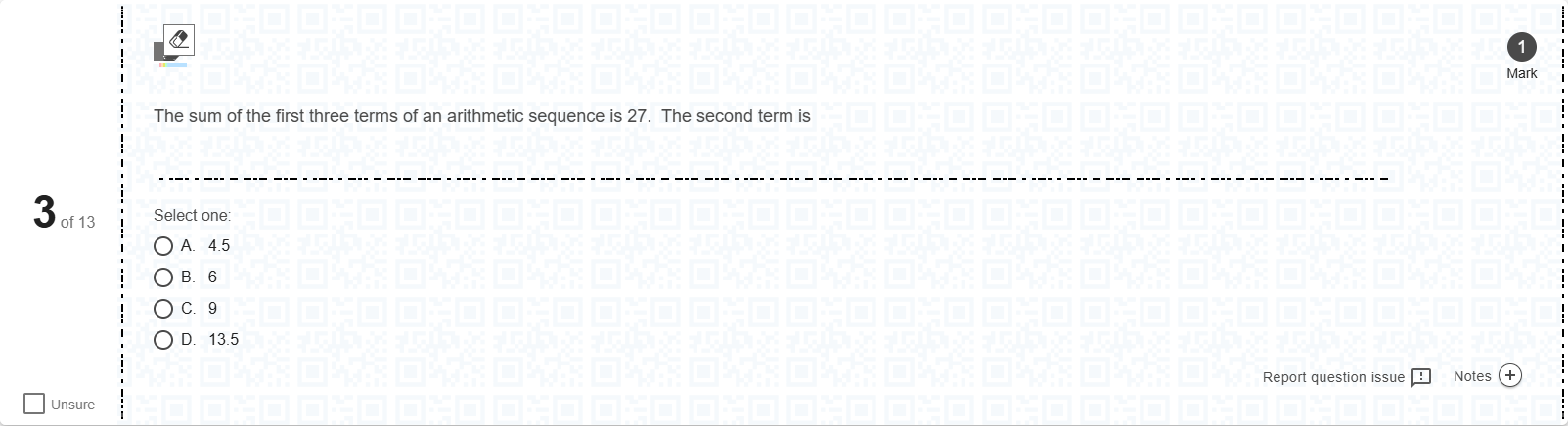
The sum of the first three terms of an arithmetic sequence is 27. The second term is[Fill in the blank]
Options
A.A. 4.5
B.B. 6
C.C. 9
D.D. 13.5

View Explanation
Verified Answer
Please login to view
Step-by-Step Analysis
The problem states: The sum of the first three terms of an arithmetic sequence is 27. The second term is ______.
Option A: 4.5 — If a2 were 4.5, then a1 + a2 + a3 would equal 3a2 = 13.5, n......Login to view full explanationLog in for full answers
We've collected over 50,000 authentic exam questions and detailed explanations from around the globe. Log in now and get instant access to the answers!
Similar Questions
An arithmetic sequence has first term [math: 400] and third term [math: 610] . The [math: 10th] 10^{th} term of this sequence is:
Assuming the pattern continues, which one of the following is NOT an arithmetic sequence?
The sum of the first ten terms of the arithmetic sequence 5, 7, 9, … is:
The 10th term in the sequence 2, 5, 8, … is:
More Practical Tools for Students Powered by AI Study Helper
Making Your Study Simpler
Join us and instantly unlock extensive past papers & exclusive solutions to get a head start on your studies!