
Questions
APBIO142-030 with labs Unit 6 Test
Single choice
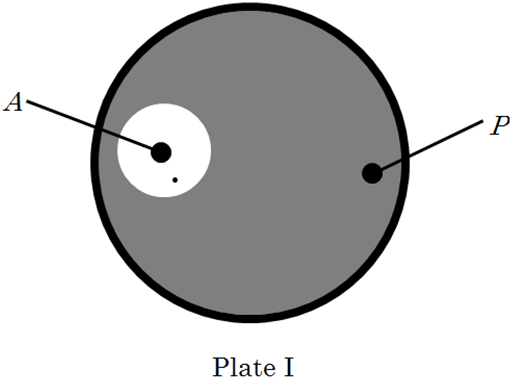
A sterile agar plate, I, is streaked with a pure culture of bacteria by means of aseptic techniques. Paper discs treated with the antibiotics Aureomycin (A) and penicillin (P) are placed at opposite sides of the plate, as shown in the diagram above. The plate is examined after a 24-hour incubation period, and a clear ring is discovered around disc A, but not around disc P. Within the clear ring around disc A, a single bacterial colony with physical characteristics like those of the pure culture is observed. A second sterile agar plate, II, is then streaked with this single colony and also incubated with antibiotics. Which of the following would most likely be observed in plate II after 24 hours?
Options
A.There would be a clear ring around both disc A and disc P.
B.There would not be a clear ring around either disc A or disc P.
C.A clear ring larger than that around disc A in plate I would appear around disc P only.
D.A clear ring smaller than that around disc A in plate I would appear around disc P only.
E.A clear ring larger than that around disc A in plate I would appear around disc A only.

View Explanation
Verified Answer
Please login to view
Step-by-Step Analysis
To tackle this question, let’s break down what the observations on plate I imply and how they translate to plate II.
Option 1: There would be a clear ring around both disc A and disc P.
- A clear ring (zone of inhibition) around a disc indicates the bacteria are sensitive to that antibiotic. In plate I, a clear ring is seen only around disc A, not around disc P. This means the bacteria are susceptible to Aureomycin but not to penicillin. Therefore, predicting a clear ring around both discs on plate II would contradict the observed susceptibility pattern and the lineage of the colony used in plate II. This option is inconsistent with plate I data.
Option 2: There would n......Login to view full explanationLog in for full answers
We've collected over 50,000 authentic exam questions and detailed explanations from around the globe. Log in now and get instant access to the answers!
Similar Questions
One of the major reasons for the increase in infectious diseases is antibiotic-resistant bacteria.
Question at position 57 Which is NOT a mechanism of bacteria antibiotic resistance?Overexpression of target proteinEnzymatic inactivation or modificationDecreased uptakeProtein misfoldingClear my selection
Question at position 38 Which of the following is FALSE regarding antibiotic resistance?It is naturally occurringIt is found in untouched habitatsIt is ancientIt is a new emerging trait in bacteriaClear my selection
Question at position 34 If the developed world eliminated agricultural antibiotic use…worldwide antibiotic resistance would disappearthere would be no effect on agricultureresistance would still be an issue due to misuse in the developing worldall of the aboveClear my selection
More Practical Tools for Students Powered by AI Study Helper
Making Your Study Simpler
Join us and instantly unlock extensive past papers & exclusive solutions to get a head start on your studies!