
Questions
BIOL3612.MERGED.202610 Activity Questions from the Literature 2B: Preparing tRNAs and synthesizing protein
Single choice
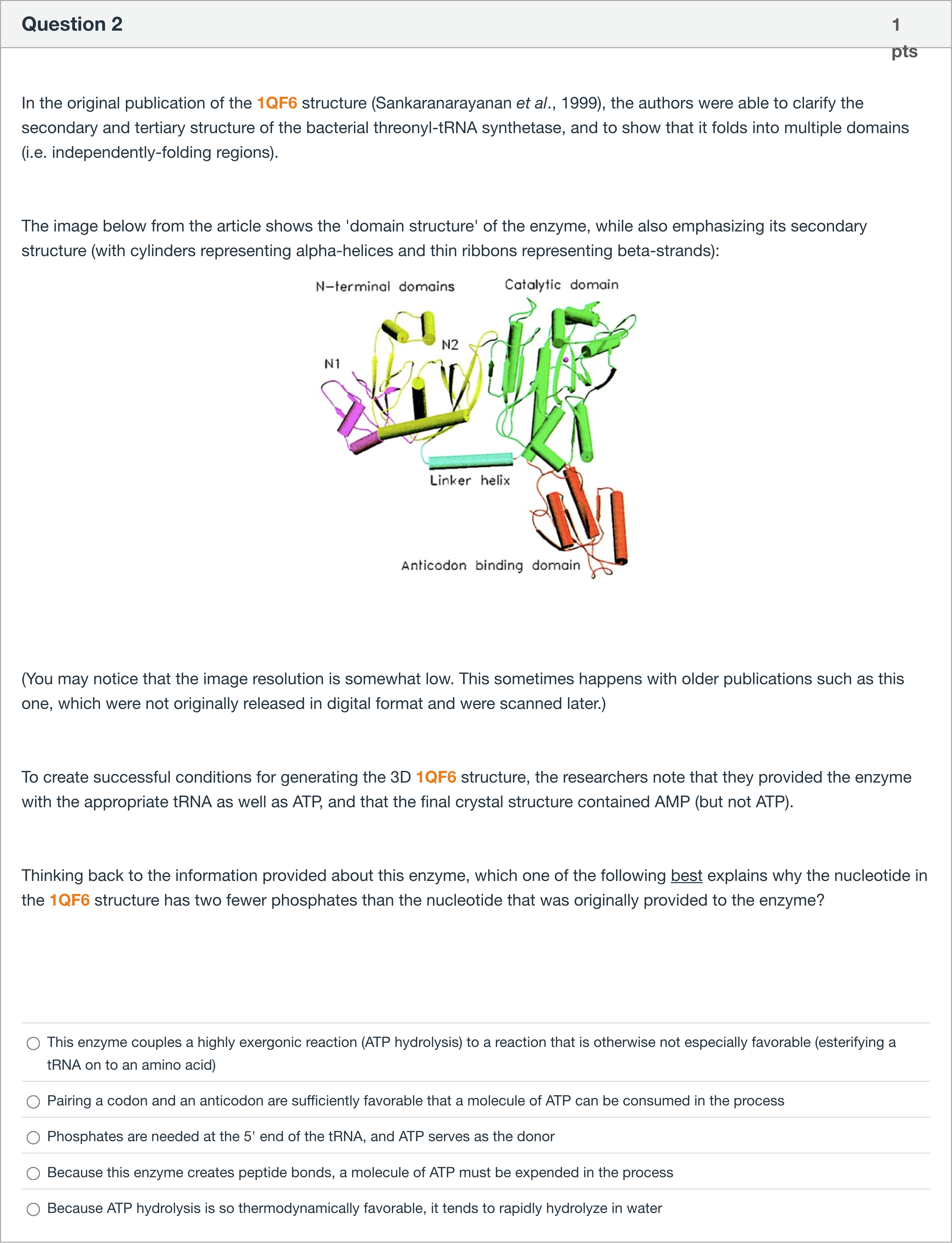
In the original publication of the 1QF6 structure (Sankaranarayanan et al., 1999), the authors were able to clarify the secondary and tertiary structure of the bacterial threonyl-tRNA synthetase, and to show that it folds into multiple domains (i.e. independently-folding regions). The image below from the article shows the 'domain structure' of the enzyme, while also emphasizing its secondary structure (with cylinders representing alpha-helices and thin ribbons representing beta-strands): (You may notice that the image resolution is somewhat low. This sometimes happens with older publications such as this one, which were not originally released in digital format and were scanned later.) To create successful conditions for generating the 3D 1QF6 structure, the researchers note that they provided the enzyme with the appropriate tRNA as well as ATP, and that the final crystal structure contained AMP (but not ATP). Thinking back to the information provided about this enzyme, which one of the following best explains why the nucleotide in the 1QF6 structure has two fewer phosphates than the nucleotide that was originally provided to the enzyme?
Options
A.This enzyme couples a highly exergonic reaction (ATP hydrolysis) to a reaction that is otherwise not especially favorable (esterifying a tRNA on to an amino acid)
B.Pairing a codon and an anticodon are sufficiently favorable that a molecule of ATP can be consumed in the process
C.Phosphates are needed at the 5' end of the tRNA, and ATP serves as the donor
D.Because this enzyme creates peptide bonds, a molecule of ATP must be expended in the process
E.Because ATP hydrolysis is so thermodynamically favorable, it tends to rapidly hydrolyze in water

View Explanation
Verified Answer
Please login to view
Step-by-Step Analysis
To approach this question, I will assess each option in turn and connect the reasoning to how ATP is used in aminoacyl-tRNA synthetase reactions.
Option 1: 'This enzyme couples a highly exergonic reaction (ATP hydrolysis) to a reaction that is otherwise not especially favorable (esterifying a tRNA on to an amino acid)'. This statement reflects the core biochemical logic: the ATP hydrolysis provides the energy to drive the formation of the aminoacyl-tRNA bond, which on its own would be unfavorably spontaneous because esterifying the tRNA with an am......Login to view full explanationLog in for full answers
We've collected over 50,000 authentic exam questions and detailed explanations from around the globe. Log in now and get instant access to the answers!
Similar Questions
Assume a mutation in the CCA arm of tRNAThr occurs that reduces the flexibility of this region of the molecule but still allows the 3′ end of the tRNA to enter the aminoacyl-tRNA synthetase activation site. Which of the following is the most likely outcome?
Two distinct classes of aminoacyl-tRNA synthetases exist. What might explain this? Please choose the correct answer from the following choices,
In a consumer society, many adults channel creativity into buying things
Economic stress and unpredictable times have resulted in a booming industry for self-help products
More Practical Tools for Students Powered by AI Study Helper
Making Your Study Simpler
Join us and instantly unlock extensive past papers & exclusive solutions to get a head start on your studies!