
Questions
ECON 2002.01 AU2025 (21333) Midterm Exam 3 - Requires Respondus LockDown Browser
Single choice
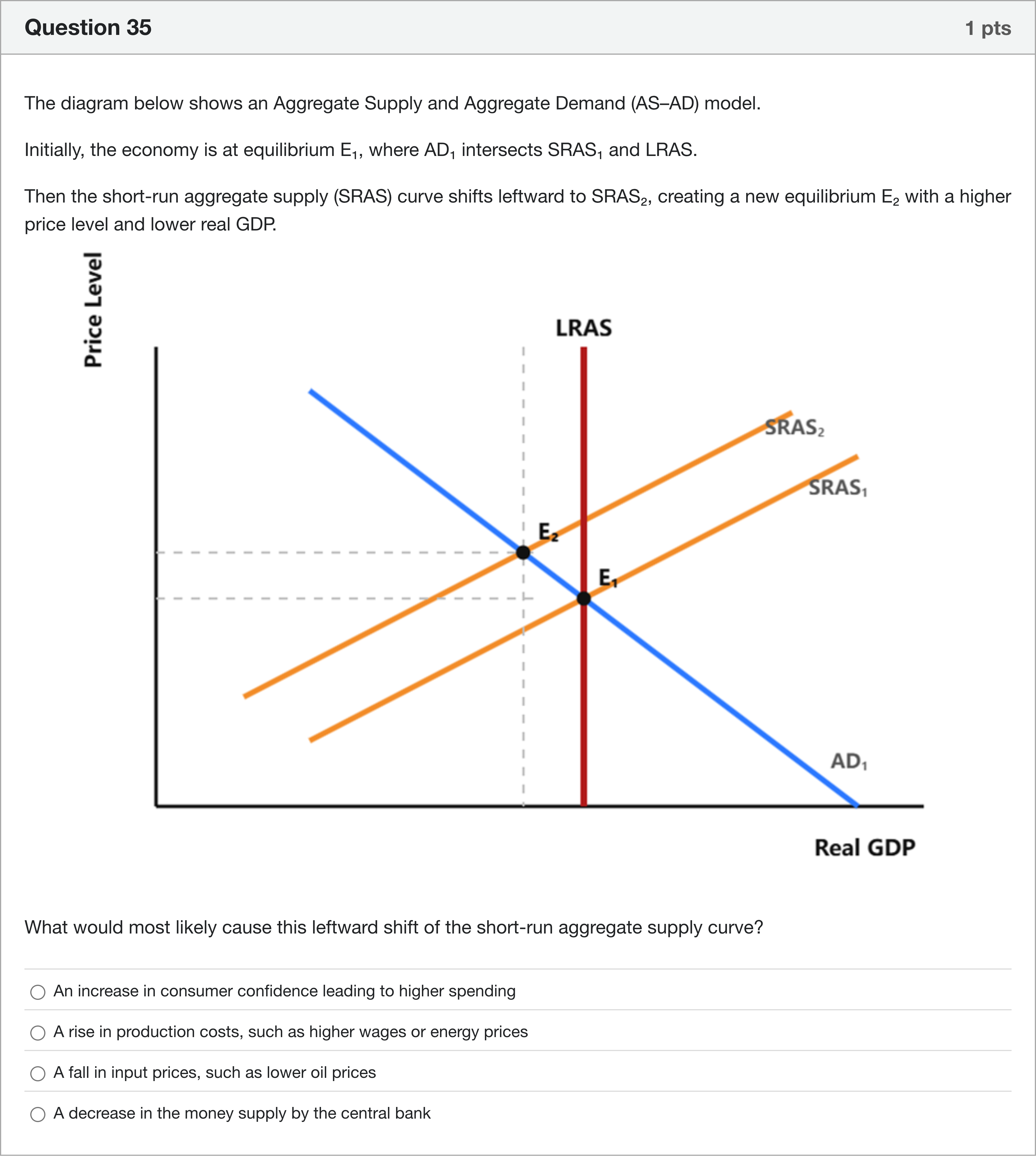
The diagram below shows an Aggregate Supply and Aggregate Demand (AS–AD) model. Initially, the economy is at equilibrium E₁, where AD₁ intersects SRAS₁ and LRAS. Then the short-run aggregate supply (SRAS) curve shifts leftward to SRAS₂, creating a new equilibrium E₂ with a higher price level and lower real GDP. What would most likely cause this leftward shift of the short-run aggregate supply curve?
Options
A.An increase in consumer confidence leading to higher spending
B.A rise in production costs, such as higher wages or energy prices
C.A fall in input prices, such as lower oil prices
D.A decrease in the money supply by the central bank

View Explanation
Verified Answer
Please login to view
Step-by-Step Analysis
To analyze what could cause the SRAS curve to shift left, consider what SRAS represents: the total production at each price level given input costs and production technology.
Option 1: 'An increase in consumer confidence leading to higher spending.' This affects aggregate demand (AD......Login to view full explanationLog in for full answers
We've collected over 50,000 authentic exam questions and detailed explanations from around the globe. Log in now and get instant access to the answers!
Similar Questions
Luke Skywalker, Princess Leia and Han Solo are in agreement about the AD curve but they are having a heated argument about the AS curve. Luke states that "only changes in short-run output can shift the AS curve", while Leia argues that "using rational expectations, only changes in the past value of inflation can shift the curve." Finally, Han Solo claims that "the steeper the AS curve, the bigger the (up or down) shift following an inflation shock." Who is right? Select all that apply.
In the late 1970s, the United States experienced a productivity slowdown that decreased the marginal product of capital. This caused:
An increase in the expected price level shifts
Consider the exhibit below for the following questions. Refer to Figure 33-1. If the economy is in long-run equilibrium, then an adverse shift in aggregate supply would move the economy from
More Practical Tools for Students Powered by AI Study Helper
Making Your Study Simpler
Join us and instantly unlock extensive past papers & exclusive solutions to get a head start on your studies!